
Top Takeaways: Fine and Gross Motor Skills
- Fine motor skills involve small muscle movements (e.g. fingers) used in writing, drawing, and dressing.
- Gross motor skills use larger muscles (arms, legs) for activities like walking, running, and jumping.
- Fine motor milestones begin at 6 months and are key to school readiness and independence.
- Gross motor skills support balance, coordination, and physical confidence in play and daily tasks.
- Shichida programs develop both skill sets through hands-on activities and age-based home routines.
From your child’s first scribbly crayon artwork to their weekend soccer game, understanding the roles of fine motor skills versus gross motor skills can make all the difference in nurturing their developmental journey. Learn the difference between fine and gross motor skills, explore your motor skills developmental milestones and explore ways to support these skills.
Fine Motor Skills vs. Gross Motor Skills: A Snapshot
Let’s take a quick look at the key differences before we explore each skill set in more depth.

What are Fine Motor skills for Kids?
Fine motor skills focus on the movement of small muscles, mainly in your little one’s hands, fingers, and wrists.
These skills are incredibly important because they serve as the building blocks for many everyday tasks that your child does.
This includes foundational milestones like writing their name with a crayon, buttoning up their shirt, or using utensils at mealtime – activities that may seem straightforward to adults but are significant stepping stones in a child’s developmental journey.
Your child will also rely on fine motor skills for other essential and fulfilling milestones. Like the day they manage to tie their shoelaces unassisted or when they correctly hold a pencil to sketch a picture.
Each of these tasks contributes to their growing sense of independence and self-reliance.
Fine motor skills also allow kids to express themselves creatively, whether in academics, sports, or the arts.
This is why many parents start focusing more on these skills as their child grows. Seeing how fine motor development is guided step by step can make it much easier to support your child at home.
Designed for families with children up to 5 years old.

Fine Motor Developmental Milestones
These milestones are signs of growing independence and markers of your child’s fine motor skills becoming more refined.
Kids develop at their own pace, so consider these milestones as general guidelines rather than strict timelines.
- 6 months: Your little one starts bringing toys to their mouth – a fine motor skill in the making!
- 9 months: Watch as your baby starts using a pincer grasp to pick up small objects— it’s a key to fine motor development.
- 12 months: Putting toys in containers and taking them out again is a sign of emerging fine motor skills.
- 18 months: If your toddler is starting to scribble or attempting to use a spoon, these are encouraging steps in fine motor development.
- 2 years: Stacking four or more blocks and following simple two-step instructions are good indicators of advancing fine motor skills.
- 3 years: Turning the pages of a book one at a time and maneuvering buttons are more refined fine motor skills to look out for.
- 4 years: Your child may start using scissors or drawing basic shapes—these are notable fine motor achievements.
- 5 years: Being able to draw more detailed figures and writing some letters indicates solid progress in fine motor skills development.
If you’re reading through this and wondering where your child fits, you’re not alone! These milestones are helpful guides – but knowing how to support each stage is what really makes the difference. If you’re not sure how to guide these skills at home, seeing it in action makes it much clearer. You can book a Shichida trial class to watch how we build these step by step.
Why are Fine Motor Skills for Kids Important?
When it comes to your child’s growth, fine motor skills might not be the first thing that comes to mind. However, fine motor skills are closely related to mental development.
Starting to nurture these skills early in your child’s life can offer benefits beyond the fun of playing with toys.
Here’s why fine motor skill development should be nurtured from infancy:
School-Ready Skills
Early stacking, scribbling, and other fine motor activities set the stage for the more complex tasks your kiddo will tackle in school.
Boosting Hand-Eye Coordination
Activities like gripping toys improve hand-eye coordination, a helpful skill in everyday life and future sports or musical activities.
Building Confidence and Independence
Mastering fine motor skills, like buttoning a shirt, boosts your child’s self-confidence and fosters independence.
It’s often these small, everyday skills that make the biggest difference in how confident your child feels. With the right kind of input early on, these abilities can develop much more naturally.
Activities to Boost Fine Motor Skills
The Shichida Australia program teaches fine and gross motor skills across our baby and toddler classes.
Enhancing a baby’s finger dexterity paves the way for mastering essential life skills, such as self-feeding, drawing, writing, and much more.
Proficiency can accelerate rapidly when a child is given ample opportunities to explore objects and engage in hands-on activities.
In our toddler classes, examples of fine motor skill activities include picking up small objects with their fingers, drawing, and learning to create controlled lines—whether they’re straight, wavy, spirals, or zig zags.
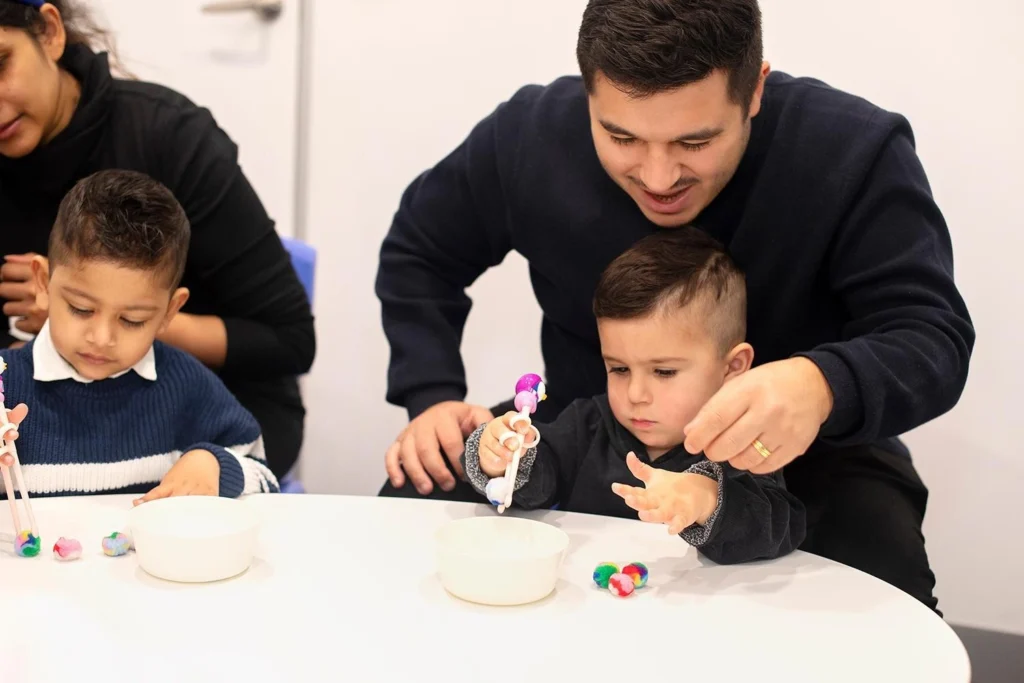
We also teach skills such as buttoning, using utensils in imaginative play, tying knots, and developing precision in manipulating small objects with tweezers and chopsticks.
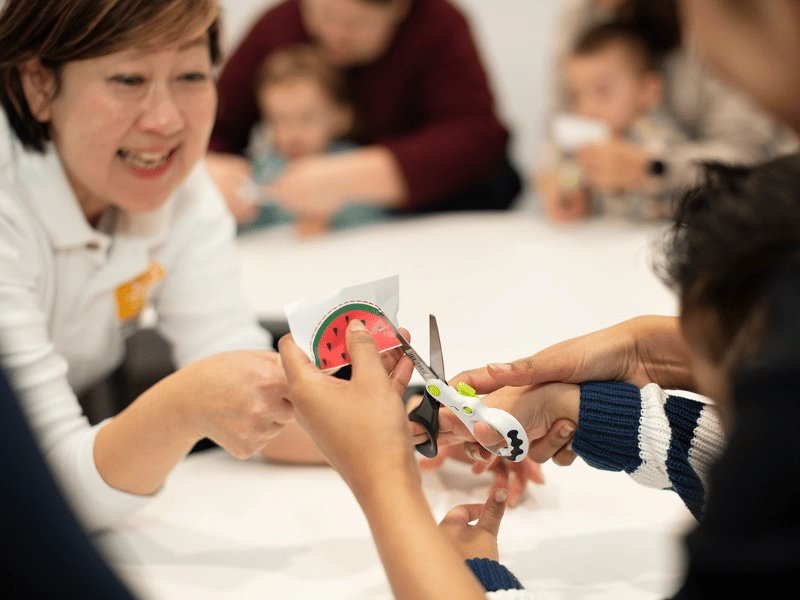
Additional activities include cutting, glueing, folding origami, and opening and closing small containers.
For older kids in our kinder classes, we build on these foundations by introducing writing, advanced drawing techniques accompanied by drawing songs, as well as cutting and folding complex shapes that include 3D objects and intricate origami designs.
Fine motor skill activities to try at home:
Fine and Gross Motor Skills For Younger Kids:
Pick up small objects: Strengthens finger grip, which is important for handwriting.
Drawing lines: Helps improve control over hand and finger movements.
Buttoning: Aids in hand-eye coordination and fosters independence in dressing.
Using utensils in play: Prepares them for actual mealtime.
Cutting and glueing: Develops hand control for detailed tasks.
Folding origami: Enhances attention to detail and control.
Fine and Gross Motor Skills For Older Kids:
Writing: Refines hand control for better handwriting.
Cutting complex shapes: Improves spatial understanding and manual dexterity.
Advanced origami: Takes their folding skills to the next level, requiring more precision.
Each of these activities targets specific fine motor skills that will benefit your child in daily activities and academic tasks.
Many parents try to piece these activities together at home – but knowing which ones to use and when can feel overwhelming! That’s where guided support can make things much simpler.
Looking for a weekly baby, toddler or preschooler class with fine motor activities and developmental benefits? Shichida offers fun, guided classes across Melbourne, with centres in Chadstone, Doncaster, Glen Waverley and Highpoint. Families in Sydney can also join us at Burwood, Chatswood and Parramatta.
What are Gross Motor Skills?
Gross motor skills refer to the abilities usually acquired during childhood and are essential for performing everyday activities.
They involve the larger, stronger muscle groups used for tasks like running, jumping, and balancing.
Essentially, they are the skills that get your kids from point A to point B.
Why are Gross Motor Skills for Kids Important?
A Foundation for Physical Fitness
Good gross motor skills form the basis of a healthy, active lifestyle. Children who develop these skills are more likely to engage in sports, dance, and other physical activity.
Building Coordination and Balance
These skills also contribute to your child’s balance and coordination. This means not only better athletic abilities but also fewer bumps and tumbles.
Social Interaction and Teamwork
Many gross motor activities are also social activities. Think of a toddler playgroup or a team sport. These activities help kids learn how to work together and build social skills.
Gross Motor Developmental Milestones
As with fine motor skills, tracking your child’s developmental milestones in gross motor abilities is important.
Typical gross motor developmental milestones:
- Six months: Your baby starts to roll over, an early sign of gross motor development.
- Nine months: Sitting without support and crawling are significant milestones in your baby’s gross motor skills.
- Twelve months: Your child begins to stand well, marking the start of more complex gross motor activities.
- Eighteen months: Walking alone and ascending stairs show your toddler is progressing in gross motor development.
- Two years: Kicking a ball and standing on tiptoes signal improved bodily control.
- Three years: Running smoothly and climbing stairs one foot per step indicate advanced gross motor skills.
- Four years: Hopping on one foot and being able to stand on one foot for two seconds are signs of further refinement in gross motor abilities.
- Five years: The ability to stand on one foot for 10 seconds indicates a strong foundation in gross motor skills.
Why It’s Important to Nurture Gross Motor Skills from an Early Age
Here’s why nurturing gross motor skills early is crucial for your child’s overall growth:
Fun and play: Gross motor skills enable children to enjoy games that also enhance social skills.
Future athletes: Skills like running and catching objects set the stage for possible future athletic endeavours.
Everyday independence: Gross motor skills are vital for daily tasks like walking to school or climbing stairs.

Supporting Your Child’s Development Starts Here
You’ve just seen how much goes into developing your child’s movement, coordination, and confidence. But knowing what to look for is only the first step.
What really makes the difference is having the right kind of input at the right time.
At Shichida, we focus on building the skills that support everything else – especially fine motor control, focus, and early learning abilities that children rely on as they grow.
In every class, you’ll see how structured activities, guided play, and simple techniques come together to support your child’s development in a way that’s both effective and enjoyable.
Book a trial class and experience how it all works in real time.
FAQ: Fine and Gross Motor Skills for Kids
Gross motor skills are movements that use the large muscles of the body, including the arms, legs, and core. These skills allow children to perform everyday actions like walking, running, jumping, and climbing. They play an important role in building balance, coordination, and physical confidence, forming the foundation for more complex skills as your child grows.
Common examples of gross motor skills include movements like walking, running, jumping, climbing, throwing, kicking, and balancing.
These skills can be grouped into different types:
- Locomotor skills (moving from one place to another, like walking or running)
- Object control skills (interacting with objects, like throwing or catching)
- Stability skills (maintaining balance and control, like standing on one foot)
Each type plays a different role in your child’s physical development, which is why a mix of activities is important.
Most children begin walking independently between 9 and 15 months, though this can vary. Some may take their first steps earlier, while others take a little more time. What matters most is steady progress through earlier milestones like rolling, sitting, and pulling up to stand.
If your child isn’t walking by around 18 months, it may be worth checking in with a healthcare professional for guidance.
The best way to support gross motor development is through regular, active play. Simple activities like running, climbing, dancing, and playing with balls can help build strength and coordination. Encouraging movement in a safe, open space allows your child to explore what their body can do while building confidence over time. You don’t need complicated setups – consistency and variety are what make the biggest difference.
Delays in gross motor development can be influenced by a combination of factors, including muscle tone, limited opportunities for movement, or environmental factors like reduced active play. In some cases, children simply develop at their own pace. However, if your child is missing key milestones – such as not crawling, walking, or showing difficulty with basic movements – it’s best to seek professional advice early.
Gross motor skills involve large muscle movements like walking, jumping, and climbing, while fine motor skills focus on smaller movements using the hands and fingers, such as writing, drawing, or buttoning clothes. Both are essential and work together. For example, strong core stability (a gross motor skill) supports better control when writing (a fine motor skill).
Gross motor skills play an important role in supporting fine motor development. Strong core muscles, balance, and coordination help your child stabilise their body so they can use their hands more effectively. For example, sitting upright, controlling arm movements, and maintaining posture all rely on gross motor strength. These are essential before a child can develop fine motor skills like writing, drawing, or using utensils.
When both skill sets develop together, children find it easier to complete everyday tasks with confidence and control.
While gross motor skills develop naturally through active play, the Shichida Method focuses more on fine motor skills and overall brain development. In class, children engage in hands-on activities that build finger strength, coordination, and control. These include drawing, gripping, sorting, and using tools like tweezers or scissors – skills that support writing and independence.
At the same time, Shichida develops memory, focus, and thinking skills through structured activities, helping children build both confidence and capability across all areas of development.