Key Points
- Positional language helps children understand where objects are and how they relate to each other in space.
- Learning words like under, behind, between, and next to supports early maths, listening, and classroom readiness.
- The best positional language activities are simple, playful, and easy to do during everyday routines.
- Toddlers often start with basic concepts like in, out, up, and down, while preschoolers can handle more detailed directions and comparisons.
- Positional language development supports confidence, problem-solving, and later learning across maths, reading, and spatial reasoning.
Your child starts learning positional language long before they can explain it out loud. Every time they crawl under a table, place a toy beside a chair, hide behind a curtain, or climb over a cushion, they are building early spatial understanding. These everyday moments help children learn how objects relate to one another in space, which supports language, problem-solving, coordination, and early maths.
Positional language activities help children learn words such as under, over, next to, between, in front of, and behind through play. These words may seem simple, but they are powerful building blocks for following instructions, describing what they see, understanding stories, and preparing for school readiness. The good news is that these concepts can be taught through movement, conversation, and hands-on play woven into daily life.
Designed for families with children up to 5 years old.

What Is Positional Language?
Positional language refers to words that describe where a person or object is in relation to something else. Common examples include in, out, on, under, over, behind, in front of, next to, between, near, and far.
Children build positional language by moving through space, watching how objects relate to each other, and hearing adults use these words in real situations. Over time, they begin to understand these concepts first, then use them in their own speech.
You may notice positional language developing when your child:
- puts a toy under the table
- hides behind the couch
- places blocks on top of each other
- follows directions like “stand next to me”
- describes where a character is in a picture book
Strong positional language skills support early maths development, spatial reasoning, reading comprehension, and classroom readiness. Research consistently shows that play-based learning is one of the most effective ways to build these skills.
Not sure if you are doing enough at home? Shichida can show you developmentally appropriate games and activities that support reaching developmental milestones – book a trial class!
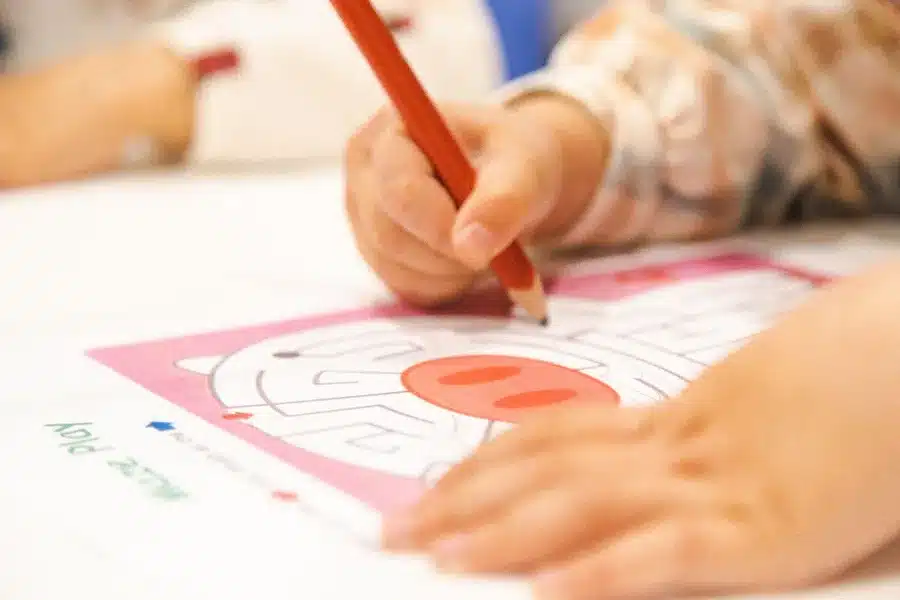
Image from Shichida Australia: Mazes are a fun way to build positional language with preschoolers. As they trace the path, use simple words like “go around,” “move up,” “down,” “through,” and “next to” to help them describe where they’re going.
Why Positional Language Matters in Early Learning
Research suggests that spatial language does more than help children describe where things are. Words like “inside,” “next to,” “around,” and “between” may also support early maths learning by helping children build the thinking skills they need for numbers, counting, and problem-solving.
Positional language matters because it helps children make sense of space, directions, and relationships between objects. These skills are important in everyday life, but they also support learning in more ways than many parents realise.
When children understand positional words, they are better able to:
- follow instructions such as “put your hat on the shelf” or “sit beside your bag”
- talk clearly about what they see and do
- understand early maths concepts and compare objects
- follow picture cues, story events, and classroom routines
- build confidence when navigating space, play, and problem-solving tasks
For example, when a child understands “Put the teddy behind the box” or “Stand between the cones,” they are building both language and spatial reasoning at the same time.
When Positional Language Develops in Children
Children usually develop these skills gradually:
- Infants: track moving objects, reach, and respond to simple cues
- Toddlers: begin understanding in/out, up/down, on/off
- Preschoolers: use a wider range of spatial words confidently in play
As language, movement, and exploration grow together, spatial understanding becomes stronger.
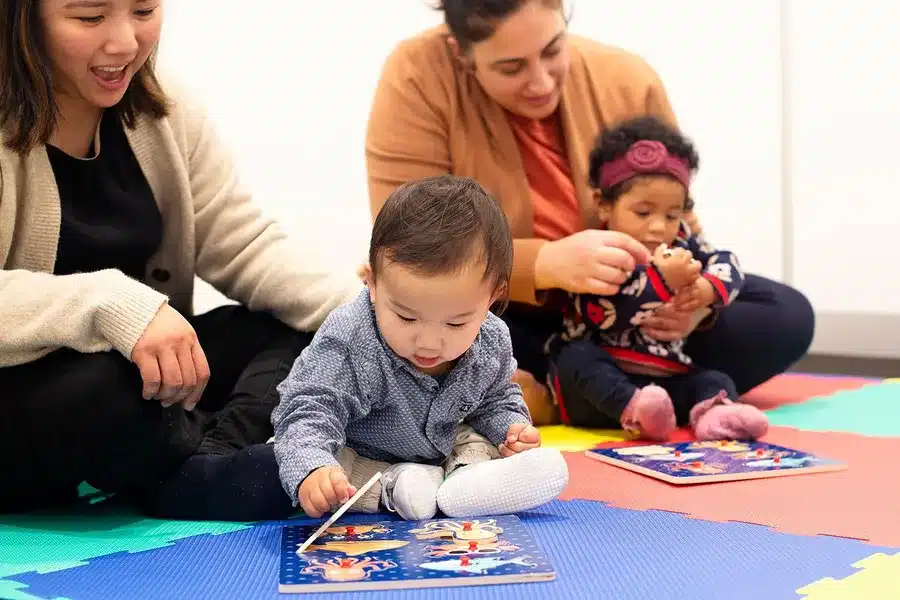
Image from Shichida Australia: As your baby plays with knob puzzles, talk through each little action: “Pick it up,” “put it down,” “turn it around,” or “place it in the hole.” These simple words help babies connect movement, meaning, and positional language through play.
Key Benefits of Positional Language Activities for Children
Practising spatial concepts through play strengthens both critical thinking and language skills. It helps children describe what they see, compare objects, solve problems, and understand how things fit together.
These early experiences build:
- spatial reasoning
- mathematical vocabulary
- visual perception
- logical thinking
- early problem-solving
Frequent practice also improves directional awareness, measuring understanding, and classification skills, all of which are useful for early school tasks.
Develops Spatial Reasoning and Awareness
Spatial thinking helps children:
- understand maps and directions
- recognise shapes and geometry
- follow diagrams or picture instructions
- move safely through environments
- build foundations for early STEM learning
Builds Mathematical Language and Vocabulary
When children learn words such as bigger, smaller, beside, heavier, or more, they gain tools to express mathematical ideas clearly.
This helps them:
- compare quantities
- understand teacher instructions
- explain their thinking
- build early numeracy confidence
Supports Problem-Solving and Logical Thinking
Sorting, comparing, and classifying activities encourage children to:
- observe carefully
- make decisions
- test ideas
- explain choices
These are valuable classroom readiness skills.
Easy Positional Language Activities for Toddlers and Preschoolers
The best activities are simple, playful, and easy to do with household items. You do not need expensive resources. A few toys, containers, blocks, or everyday objects are enough.
Positional Language Games Using Everyday Objects
Simple household items can make positional language practice more concrete and fun.
Try:
- placing a toy in a box, on a box, and under a box
- asking your child to put a spoon beside a bowl
- lining up soft toys next to each other
- hiding an object behind a cushion or between two chairs
- using blocks to show on top of, under, and in front of
These activities help children connect positional words to real actions and real spaces.
Movement-Based Positional Language Activities
Children often learn positional language best when they can move their bodies.
Try:
- obstacle courses using under, over, through, and around
- asking your child to stand behind a chair or next to a toy basket
- playing follow-the-leader with directions like in front of, beside, and between
- jumping inside and outside chalk circles
- crawling under a blanket tunnel
Movement helps children feel the meaning of positional words instead of only hearing them.
Positional Language Activities in Books and Storytime
Books are a great way to reinforce positional language because children can see and talk about where characters and objects are.
Try:
- asking “Where is the cat?” while reading a picture book
- pointing out objects above, below, or next to each other in illustrations
- asking your child to describe where a character is hiding
- using flap books to talk about things behind doors or under covers
- retelling a story using positional words
This builds vocabulary, comprehension, and confidence using language in context.
Positional Language Activities During Daily Routines
Some of the best positional language practice happens in normal daily life.
Try:
- asking your child to put shoes under the bench
- placing a cup next to the plate at mealtimes
- putting toys back in the basket
- asking them to sit between two cushions during storytime
- talking about who is in front of or behind while walking
This kind of repetition helps positional language feel natural and useful.
10 Fun Positional Language and Spatial Concept Activities for Early Learners
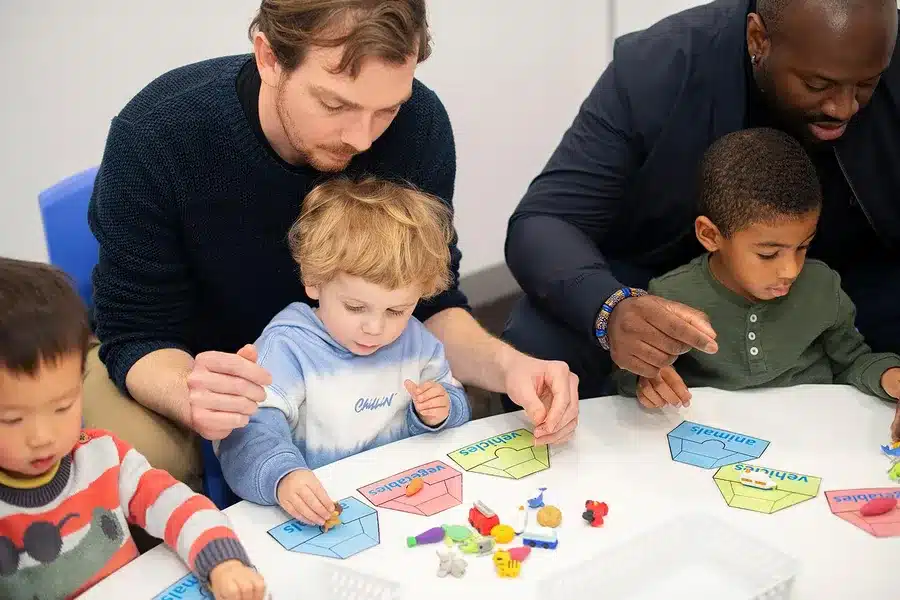
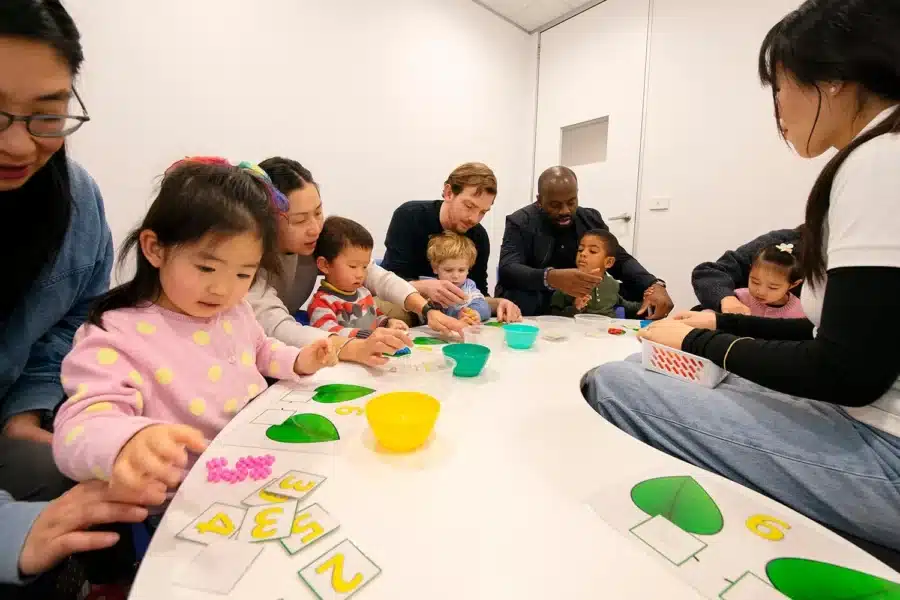
Image from Shichida Australia: Guided by a teacher, parental support helps strengthen positional language activities through hands-on learning and rich conversation.
- Treasure Hunt with Positional Clues
Hide a toy and give clues such as “Look under the table” or “Check behind the chair.”
Builds: listening, positional vocabulary, problem-solving
Best for: ages 3 to 5 - Toy Placement Game
Ask your child to place a toy in the basket, on the cushion, or beside the door.
Builds: understanding of basic positional words
Best for: ages 2 to 4 - Obstacle Course Directions
Use simple instructions like crawl under, jump over, stand between, and walk around.
Builds: body awareness, movement, spatial understanding
Best for: ages 3 to 6 - Picture Book Position Hunt
Look through picture books and ask where characters or objects are in relation to each other.
Builds: comprehension, expressive language, observation
Best for: ages 2 to 5 - Block Building Language Play
Build towers and talk about which block is on top, next to, or under another one.
Builds: spatial reasoning, vocabulary, construction play
Best for: ages 3 to 5 - Soft Toy Hide-and-Seek
Hide a teddy behind a cushion, inside a box, or under a blanket and ask your child to find it.
Builds: positional understanding, memory, playful language use
Best for: ages 2 to 4 - Follow-the-Leader Directions
Give commands such as “Stand behind me” or “Sit next to the chair.”
Builds: listening, confidence, following directions
Best for: ages 3 to 5 - Sticker Scene Activity
Use a picture scene and ask your child to place stickers above, below, between, or next to objects.
Builds: fine motor skills and positional vocabulary
Best for: ages 3 to 5 - Chalk Path Game
Draw circles and lines outside, then ask your child to jump inside, stand outside, or move around them.
Builds: movement-based learning and spatial concepts
Best for: ages 3 to 6 - Daily Routine Helper Game
Turn tidy-up or mealtimes into a game by asking your child to place items in specific positions.
Builds: real-life understanding, independence, language use
Best for: ages 2 to 5
Want more ideas? Shichida has plenty!

Signs a Child May Need More Positional Language Practice
Children develop positional language at different rates, so occasional confusion is completely normal. Some children simply benefit from more repetition, more movement, and more chances to hear and use these words in everyday life.
You may want to offer extra support if your child often:
- struggles to follow simple directions such as under, behind, or next to
- avoids games that involve sorting, placing, or following movement instructions
- finds it hard to describe where objects are
- becomes frustrated when asked to organise objects by position
- needs repeated help with simple spatial routines
In many cases, playful daily practice helps a lot. If concerns continue, it may be helpful to speak with your GP, child health nurse, early childhood educator, or paediatric professional.

Tips for Helping Children Develop Spatial and Positional Skills
Use positional words often
Children learn these concepts faster when they hear them regularly in real situations. Say things like “Your hat is on the chair,” “The book is under the table,” or “Stand beside me.”
Start simple
Begin with easy opposites such as in and out, up and down, or on and off. Once your child understands those, move on to words like between, behind, and in front of.
Pair words with action
Children understand positional language more easily when they can move, place, crawl, jump, or point while hearing the words.
Repeat naturally
You do not need formal lessons. Repeating the same words during play, meals, tidying, and storytime helps children remember and use them.
Keep it playful
The goal is not to test your child. It is to help them build understanding through fun, movement, and connection.

How Spatial and Positional Skills Support Long-Term Learning
Early spatial development supports much more than preschool play. It helps children succeed in:
- mathematics and number sense
- reading and writing
- STEM thinking and design
- creative construction play
- problem-solving tasks
Children who feel confident understanding space, direction, and comparison often approach learning with more independence and enthusiasm. They can follow routines, tackle puzzles, explain ideas, and engage more confidently in the classroom. Programs that nurture whole brain development can further strengthen these essential learning foundations.
Helping your child build these skills now creates a strong foundation for years to come.
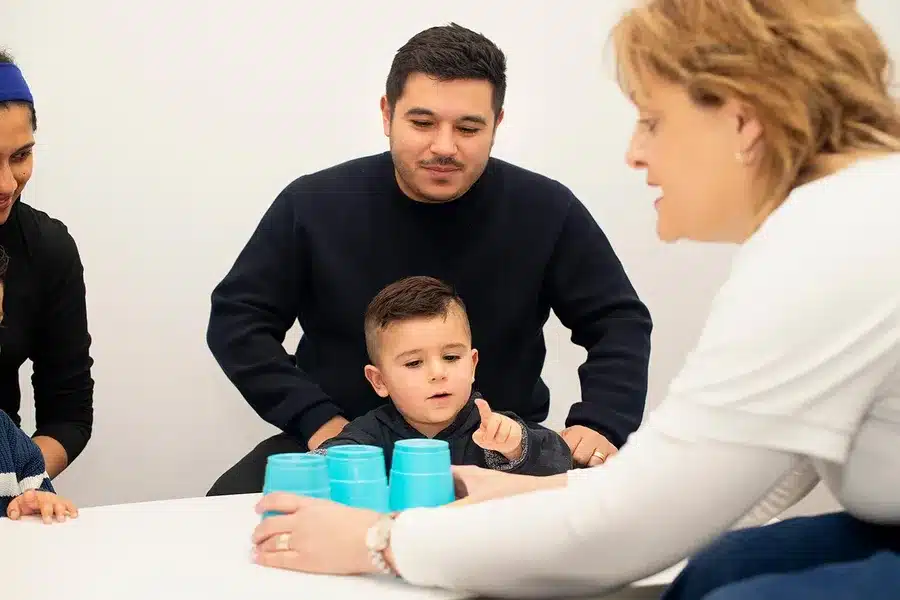
Image by Shichida Australia: A simple cup activity that develops intuition, can help toddlers and preschoolers practise positional language while strengthening concentration and confidence.
How Shichida Supports Positional Language and Spatial Learning
At Shichida Australia, children build early learning skills through rich, guided experiences that strengthen listening, memory, focus, language, and spatial awareness. Positional language grows naturally when children follow directions, respond to visual cues, move through activities, and talk about what they see and do.
These early spatial concepts matter because they support more than maths. They help children become more confident communicators, more independent learners, and more prepared for the classroom. If you would like to see how Shichida nurtures these foundations in a joyful, structured setting, book a trial class.
FAQs: Positional Language Activities for Kids
Positional language activities for preschoolers are play-based games that teach words such as under, over, behind, next to, and between. These activities help children understand where objects are in space and support early maths, listening, and classroom readiness.
Positional language is important because it helps children follow instructions, describe what they see, understand stories, and build early maths concepts. It also supports spatial reasoning, problem-solving, and confidence in everyday routines.
Children usually begin understanding simple positional concepts in toddlerhood, such as in, out, up, and down. Their use of more detailed words like behind, between, and in front of often grows during the preschool years through repeated play and conversation.
Good positional language activities for toddlers include hiding toys under cushions, putting objects in and out of containers, placing items on and off surfaces, and following simple movement directions. These playful activities make early spatial concepts easier to understand.
You can teach positional language at home by using these words during everyday routines, storytime, tidy-up, obstacle courses, and toy play. The most effective approach is to pair the words with actions, so your child can see and feel what each position means.
Positional language is the vocabulary children use to describe where things are, while spatial reasoning is the broader ability to understand how objects relate to each other in space. Positional language helps build spatial reasoning by giving children words for the concepts they are learning.
Yes, positional language activities support school readiness by helping children follow instructions, understand classroom directions, describe ideas clearly, and build early maths and problem-solving skills.
Blocks, puzzles, dolls, toy animals, cars, containers, construction toys, and picture books are all useful for positional language practice. The best toys are the ones that let children move, place, compare, and describe objects in space.
Short, daily practice is usually best. Children learn positional language most naturally when it is repeated often in play, routines, and conversation rather than taught in long formal sessions.
Shichida supports spatial and positional learning through structured, play-based activities that build listening, memory, focus, language, and early numeracy. These experiences help children strengthen the foundations they need for confident learning.