
Key Takeaways
- Phonemic awareness is your child’s ability to hear and work with sounds in words (not letters)
- It is one of the strongest predictors of reading success
- Children develop phonemic awareness before they learn to read
- The best phonemic awareness activities are short, spoken, and play-based
- Just 5–10 minutes a day can significantly support early literacy development
- Strong sound awareness makes phonics, reading, and spelling much easier later on
Who This Guide Is For
This guide is designed for parents of children aged 3 to 5 years old who want to:
- Build strong early reading skills at home
- Understand what actually prepares a child for reading
- Use simple, effective activities without overwhelming their child
If you’ve ever wondered how to teach your child to read, it doesn’t start with books. It starts with sounds.
Before your child can recognise letters or read words, they need to hear, break apart, and play with sounds. This is called phonemic awareness, and it’s one of the most important early literacy skills for children aged 3 to 5.
With the right phonemic awareness activities, you can support your child’s reading development through simple, playful moments at home, even in just a few minutes a day.
Designed for families with children up to 5 years old.

What Is Phonemic Awareness?
Phonemic awareness is your child’s ability to hear, identify, and play with individual sounds in spoken words. These sounds are called phonemes.
For example, when you ask your child, “What sound does cat start with?” and they say /k/, they are using phonemic awareness. If they can stretch dog into /d/ /o/ /g/, that’s another clear sign.
It’s important to know this: phonemic awareness is completely auditory. Your child does not need to see letters or read words to develop it. In fact, it should happen before formal reading begins.
This skill sits within a broader group called phonological awareness, but phonemic awareness is more specific and more closely linked to reading success. Research from early literacy experts like Reading Rockets and Five from Five consistently shows that children with strong phonemic awareness are better prepared to read, spell, and decode words later on.
Phonemic Awareness vs Phonological Awareness
It’s easy to mix these up, so here’s a simple way to think about it.
Phonological awareness includes all sound-based skills, like:
- Recognising rhymes (cat, hat)
- Clapping syllables (ba-na-na)
- Hearing repeated sounds (big brown bear)
Phonemic awareness is more focused. It’s about individual sounds in words.
So when you ask:
- “Do cat and hat rhyme?” – this is phonological awareness
- “What sound does cat start with?” – this is phonemic awareness
Both matter, but phonemic awareness is what directly supports reading development.
Why Phonemic Awareness Matters in Early Learning
When your child can hear and work with sounds, reading becomes much easier.
Strong phonemic awareness helps your child:
- Sound out words when they start reading
- Spell more accurately
- Feel more confident with language
Early childhood research, including guidance from NSW Education, shows that children who develop these sound skills early are far less likely to struggle with reading later. In simple terms, you are setting your child up for success before they even open a book.
This is why many parents also look into structured early learning programs that build these skills consistently.

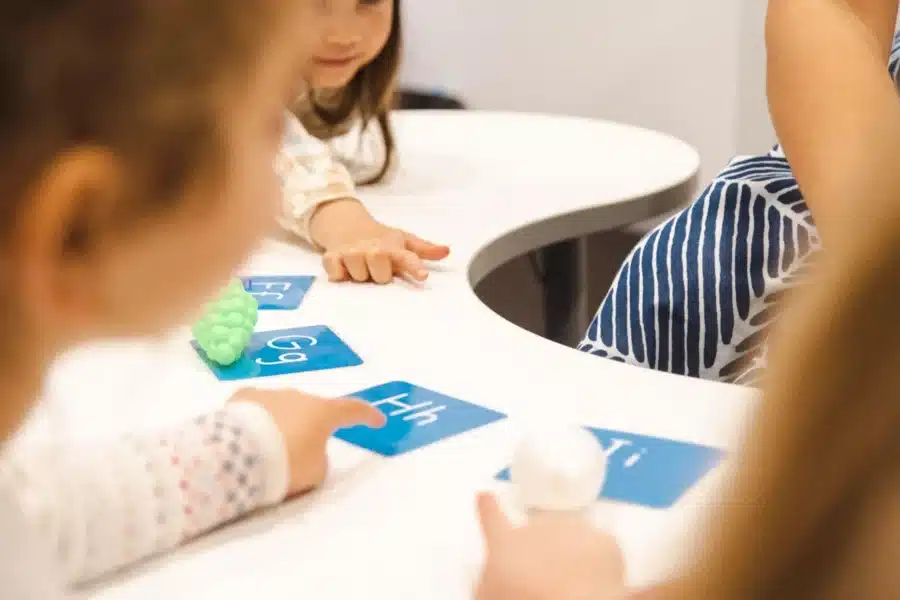
Image by Shichida Australia: Phonemic awareness is woven into each play-based Shichida class activity. Kids learn without even knowing it!
Key Phonemic Awareness Skills Children Develop
Phonemic awareness doesn’t happen all at once. Your child builds it step by step, moving from simple listening skills to more complex sound play.
Following this progression really matters. If activities are too advanced too soon, your child may feel confused or lose interest.
Sound Identification (Beginning Sounds)
This is where most children start.
Your child learns to recognise the first sound in a word.
Example:
You ask, “What sound does sun start with?”
Your child answers, /s/.
Sound Blending
Now your child begins to put sounds together to form a word.
Example:
You say, “/c/ /a/ /t/… what word is that?”
Your child says, cat.
Sound Segmentation
This is the reverse of blending.
Your child breaks a word into individual sounds.
Example:
You ask, “Tell me the sounds in dog.”
Your child answers, /d/ /o/ /g/.
Sound Manipulation
This is the most advanced stage.
Your child can change sounds to make new words.
Example:
You say, “Say cat without the /k/.”
Your child says, at.
You say, “Change the /m/ in mat to /s/.”
Your child says, sat.

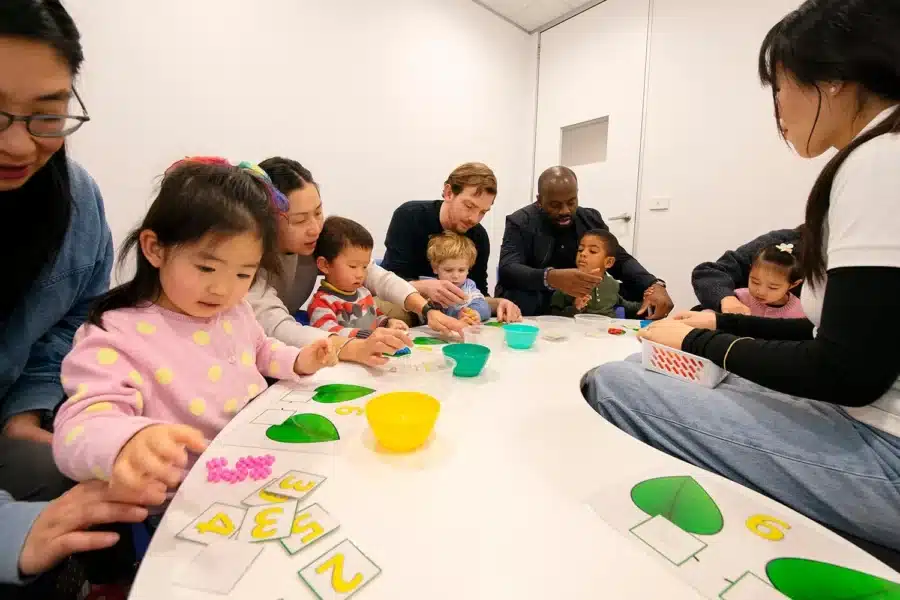
Image by Shichida Australia: A Shichida class with young children exploring letters during a group sound-matching exercise. Confidence building activities for kids help develop focus, collaboration, and a love for learning from an early age.
Phonemic Awareness Activities by Skill Level
The most effective phonemic awareness activities are simple, playful, and interactive.
Beginner Activities (Ages 3-4)
At this stage, your goal is to help your child listen and notice sounds.
Try:
- Sound matching: “Which word starts like ball: bat or sun?”
- “I Spy” with sounds: “I spy something that starts with /b/”
- Sound hunts: Look around your home for objects that start with the same sound
Keep it light. Focus on exposure, not perfection.
Intermediate Activities (Ages 4-5)
Now your child is ready to start working with sounds more actively.
Try:
- Blending games: Slowly say /d/ /o/ /g/ and let your child guess
- Clapping sounds: Clap or tap for each sound in a word
- Simple segmentation: Break short words into sounds together
Encourage your child to try, repeat, and build confidence.
Advanced Activities (Ages 5-6+)
At this stage, you’re preparing your child for reading and spelling.
Try:
- Sound substitution: “Change the /c/ in cat to /h/.” → hat
- Sound deletion: “Say smile without the /s/.” → mile
- Word challenges: Play quick games where sounds change to make new words
These activities strengthen your child’s flexibility with sounds, which is essential for phonics readiness.
Want a structured approach to these activities without guessing what to do next? Many parents choose to follow a guided program to ensure their child progresses step by step. Book a Shichida trial class to see how it works!

Image by Shichida Australia: Shichida classes are a great way to strengthen the parent-child bond while spending time together with purpose.
Fun and Play-Based Phonemic Awareness Activities
The more fun this feels, the more your child will engage.
Games and Group Activities
You can easily turn learning into a game:
- Sound guessing games
- Call-and-response sound play
- Group games where everyone says words with the same starting sound
These work especially well with siblings or playgroups.
Everyday Learning Opportunities
You don’t need extra time. Just use moments you already have.
- In the car: “What sound does truck start with?”
- At the shops: “Can you find something that starts with /m/?”
- During bath time: Play simple sound games
These small moments build strong habits over time.
Music, Rhymes, and Songs
Songs and rhymes are powerful tools for learning.
- Rhymes highlight sound patterns
- Songs slow language down so sounds are easier to hear
- Repetition helps your child remember
This is why nursery rhymes remain such an important part of early childhood learning.
If you’re looking for more ideas, Shichida has plenty!

Teaching Strategies for Effective Phonemic Awareness Development
A few simple strategies can make your efforts much more effective.
- Focus on talking and listening, not reading or writing.
- Keep practice short, around 5 to 10 minutes.
- Provide immediate feedback. If your child makes a mistake, gently guide them.
For example:
If your child says, “Cat starts with /t/.”
Gently respond, “Good try! Cat starts with /k/. Can you hear the /k/ sound at the beginning?”
Not sure if your doing enough at home? Try a Shichida class.
How Phonemic Awareness Supports Reading Development
Phonemic awareness is one of the strongest foundations for reading.
Connection to Phonics
Once your child understands sounds, they can connect those sounds to letters. This is phonics.
Without strong sound awareness, this step becomes much harder.
Impact on Reading Fluency
Children who can blend and segment sounds read more smoothly.
They spend less time guessing and more time understanding.
Long-Term Literacy Benefits
When your child develops strong phonemic awareness early, you support:
- Better reading comprehension
- Stronger spelling skills
- Greater confidence in learning
It also reduces the risk of reading difficulties later on.

Image by Shichida Australia: A young child fully engaged in a Shichida class, showing excitement during a structured learning session. Confidence building activities for kids, such as interactive sound play, build self-assurance and a love for learning.
Creating a Daily Phonemic Awareness Routine
You don’t need a complicated plan – a simple routine works best.
5-10 Minute Daily Practice Plan
Try this structure:
- 2 minutes: Sound identification
- 3 minutes: Blending or segmenting
- 2-5 minutes: A game or song
Mixing Activities for Engagement
Rotate activities to keep your child interested.
One day you might play “I Spy,” the next day a sound guessing game.
Support Your Child’s Reading Journey with Shichida Australia

While these activities are powerful at home, many parents find that consistency and progression make the biggest difference.
At Shichida Australia, phonemic awareness is built naturally through structured, engaging lessons designed for young children.
Your child will:
- Develop strong listening and sound recognition skills
- Build focus, memory, and language confidence
- Learn through fast-paced, interactive activities that keep them engaged
What makes the difference is not just the activity, but how often and how consistently your child is exposed to it.
If you want to see how this works in a real class setting:
Book a Trial Class and experience it with your child!
FAQs: Phonemic Awareness Activities for Kids
These are simple listening and speaking games that help children hear, identify, and play with sounds in words. Examples include sound matching, blending games, and “I Spy” with sounds.
Most children can begin developing phonemic awareness around age 3 through simple, play-based activities.
Phonemic awareness focuses on hearing sounds in words, while phonics connects those sounds to written letters.
Use short, daily activities like sound games, rhymes, and blending exercises. Keep it playful and consistent.
Around 5 to 10 minutes a day is enough to see progress.
They may struggle with reading later, especially with sounding out and decoding words.
They are the foundation. Once strong, children can move into phonics and reading more easily.