
Key Takeaways
- W-sitting is a common floor position in which a child sits with their bottom between their feet and their legs forming a W.
- It can feel comfortable because young children naturally have more inward rotation through their thigh bones and hips.
- A 2024 systematic review found no evidence that W-sitting causes developmental hip dysplasia and no scientific basis for routinely prohibiting it.
- A 2020 study of 104 children found no meaningful difference in hip dysplasia between children who had W-sat and those who had not.
- Current evidence does not show that W-sitting causes in-toeing, flat feet, poor posture or weak core muscles.
- Occasional W-sitting is generally not a concern in a typically developing child who moves comfortably between different positions.
- Seek professional advice if your child has pain, difficulty changing position, loss of movement skills or broader concerns with mobility or development.
“Fix your legs.” “Sit properly.” “Don’t sit like a W.”
Many parents start correcting the W sitting position after hearing that it can damage a child’s hips, weaken their core or affect the way they walk. Search online and you will still find warnings that make an ordinary sitting habit sound dangerous.
However, the available research is far less alarming. A 2024 systematic review found no scientific evidence supporting routine advice against W-sitting and no association between the position and developmental hip dysplasia.
So why is the advice so divided – and what should you actually do when your child settles into that familiar W?
Designed for families with children up to 5 years old.

Quick Answer: Is the W-Sitting Position Bad for Children?
For most typically developing children, W-sitting is a normal and comfortable position. Current research does not show that it causes hip dysplasia, in-toeing, contractures or functional problems. You generally do not need to correct your child every time they W-sit.
Pay attention to your child’s overall movement rather than the position alone. Speak with a GP, child health nurse or paediatric physiotherapist if your child experiences pain, cannot move comfortably between positions, loses a skill or has other movement or developmental concerns.
This article provides general information and is not a substitute for individual medical advice.
What Should Parents Do?
| What you notice | What to do |
|---|---|
| Your child W-sits comfortably, changes positions and moves normally | There is usually no need to intervene. |
| Your child W-sits frequently but can comfortably use other positions | Offer varied play and sitting options without making W-sitting forbidden. |
| Your child has pain, cannot change position, moves asymmetrically or has lost a skill | Speak with a GP, child health nurse or paediatric physiotherapist. |
What Is the W-Sitting Position?
In the W-sitting position, a child sits on the floor with:
- their bottom between their feet
- their knees bent in front of them
- their lower legs angled out beside their hips
Viewed from above, the legs form the shape of a W. The position is also sometimes called “television sitting”.
You might see your child W-sit while looking at a book, building with blocks, completing a puzzle or concentrating on another floor activity.
Why Do Children Sit in a W Position?
For many children, the simple answer is comfort.
Young children naturally have more inward rotation in their thigh bones than adults. This is known as femoral anteversion. It is a common developmental variation that generally reduces as children grow.
Children with greater inward hip rotation may find W-sitting more comfortable than sitting cross-legged. The position also gives them a wide base on the floor, allowing them to use their hands without having to make as many balance adjustments.
This does not automatically mean a child has weak muscles, poor balance or a developmental condition. Their anatomy may simply make the position easy to use at that stage.
W-Sitting Myths Versus Current Evidence
Advice about W-sitting has often been based on plausible-sounding mechanical theories rather than demonstrated long-term outcomes.
| Common claim | What current evidence says |
|---|---|
| W-sitting causes hip dysplasia | The 2024 systematic review found no association between W-sitting and developmental hip dysplasia. |
| W-sitting causes or worsens in-toeing | Femoral anteversion can make both in-toeing and W-sitting more likely, but W-sitting has not been shown to cause bone rotation. Children’s Mercy states that W-sitting does not worsen femoral anteversion. |
| W-sitting causes flat feet or poor posture | Current research has not established that W-sitting causes either condition. Associations do not prove that the sitting position caused them. |
| W-sitting weakens the core | There is no good evidence that occasional W-sitting weakens a child’s core. Research in this area is limited, and one included muscle-activation study involved adults rather than children. |
| Every child should be stopped from W-sitting | The systematic review found no scientific evidence supporting routine prohibition of the position. |
What the 2024 Systematic Review Found
The review searched five major research databases and included seven relevant studies. Its authors found that much of the existing evidence was limited or methodologically unable to show that W-sitting caused the problems attributed to it.
The review concluded that:
- W-sitting was not associated with developmental hip dysplasia
- there was no scientific evidence supporting advice to prohibit W-sitting
- the available evidence did not establish other orthopaedic deformities caused by the position
- more high-quality, long-term research is still needed
That final point is important. “No evidence of harm” does not mean every possible question has been studied perfectly. It means the confident warnings commonly given to parents are not supported by the available outcome evidence.
The strongest direct study of hips was published in 2020. Researchers reviewed hip and pelvic X-rays from 104 children and asked families about the children’s sitting habits. Hip dysplasia was found in 9% of children who currently or previously W-sat and 10% of those who had never W-sat – a difference that was not statistically significant. The researchers concluded that W-sitting was not associated with hip dysplasia.
A 2021 paediatric orthopaedic review reached a similar conclusion. It reported no scientific evidence that W-sitting leads to hip dislocation, contractures or functional deficits. In 2025, specialists at Children’s Hospital Los Angeles also advised that W-sitting is not a hip concern in typically developing children.
The International Hip Dysplasia Institute also describes W-sitting as normal for many children and states that it does not harm developing hips or contribute to hip dysplasia.
Why Do Some Professionals Still Advise Against W-Sitting?
Some physiotherapists and other clinicians still suggest limiting prolonged W-sitting. Their concerns often relate to the position’s wide base, reduced need for balance adjustments or theories about muscle use, posture and joint loading. These can be reasonable points to consider when assessing an individual child, especially one who already has pain, limited movement or a diagnosed condition.
However, a biomechanical theory is not the same as evidence that the position causes a lasting problem. The research available to date has not demonstrated the commonly claimed long-term harms in typically developing children. The most accurate advice is therefore not that W-sitting has been proven harmless in every possible circumstance, but that W-sitting alone is not a reason for parents to worry or repeatedly intervene.
The Pediatric Orthopaedic Society of North America’s OrthoKids resource likewise notes that the belief that W-sitting is bad has not been proven. As with any sitting position, the wider picture – comfort, mobility, symmetry and development – is more informative than the shape of the legs at one moment.
Does W-Sitting Make In-Toeing Worse?
In-toeing means that one or both feet turn inward while a child walks. One common cause is femoral anteversion – the same natural thigh-bone rotation that can make W-sitting comfortable.
This shared anatomy can make the two appear together. That does not mean one caused the other.
Children’s Mercy explains that femoral anteversion usually improves naturally and that sitting in the W position does not worsen it. It reports that most cases correct as children grow, generally by around 10–12 years.
When W-Sitting Is Worth a Closer Look
The most useful question is not simply, “Does my child W-sit?” It is, “How does my child move overall?”
A child might W-sit while building a tower, kneel beside a table a few minutes later, sit with their legs forward to look at a book and then stand to run outside. In that pattern, W-sitting is one of many positions.
It is worth seeking professional advice if your child:
- experiences hip, knee, leg or back pain
- appears unable to move comfortably into or out of the position
- consistently uses one side of their body differently from the other
- avoids active play because movement seems difficult or uncomfortable
- loses a movement skill they previously used
- is not meeting expected gross motor milestones
- has other changes in walking, balance, coordination or movement that concern you
W-sitting by itself is not a diagnosis. These signs are reasons to discuss the broader movement pattern with a qualified professional.
Who Should Parents Speak To?
In Australia, a GP or child health nurse can be a useful first contact. They can consider your child’s overall health and development and refer you if a more detailed assessment is needed.
A paediatric physiotherapist can assess how your child sits, stands, walks, balances and moves between positions. An assessment does not mean something is necessarily wrong; it may simply provide reassurance or practical guidance suited to your child.

Photo by Shichida Australia, taken during a baby class.
Should You Stop Your Child From W-Sitting?
For an otherwise healthy child who occasionally W-sits and moves comfortably in other ways, current evidence does not support constantly correcting the position.
Repeated instructions to “fix your legs” can also interrupt a child who is concentrating on play. Rather than treating one position as forbidden, give your child natural opportunities to use a variety of positions and movements.
Alternative Floor Positions to Offer
You can occasionally set up an activity in a way that makes another position convenient:
| Position | A simple way to use it |
|---|---|
| Cross-legged sitting | Place a book or puzzle directly in front of your child |
| Side sitting | Put toys slightly to one side so your child turns towards them |
| Long sitting | Sit with legs forward while rolling a ball back and forth |
| Kneeling or half-kneeling | Use a low table, couch or activity surface |
| Sitting on a small stool | Try drawing, sorting or fine motor play at a child-height table |
These are options, not corrective exercises. If a position causes discomfort or your child physically cannot use it, do not force it. Ask a health professional for individual advice.
Photo by Shichida Australia, taken during a toddler class.
Movement, Coordination and Early Learning
Physical and cognitive development do not occur in completely separate worlds. A simple play activity can involve movement, attention, memory, language, problem-solving and fine motor control at the same time.
Shichida Australia’s guide to gross motor skills, developmental stages and milestones explains the larger movements involved in running, jumping, climbing and balancing. Its gross motor activities for preschoolers and guide to building gross motor skills through play provide additional age-appropriate ideas.
Looking for structured activities suited to your child’s age? Shichida is an early learning program for babies, toddlers and preschoolers. Weekly parent-and-child classes use short activities involving music, memory, flashcards, language, thinking and hands-on learning. Book a class today!
How This Connects With Shichida Classes
Shichida classes are early learning classes, not physiotherapy. They do not treat W-sitting, in-toeing or postural concerns.
The connection is variety. In each weekly class, children take part in more than 20 short activities involving music, language, memory, early numeracy, problem-solving and hands-on tasks. The parent joins the class, helping children feel secure while seeing practical ways to support learning.
Toddler Classes are available for children aged one to three, while Kinder Classes are designed for children aged three to five. The program also begins with baby classes from six months old.
You can also find simple home activities in Shichida Australia’s motor skill games for children.
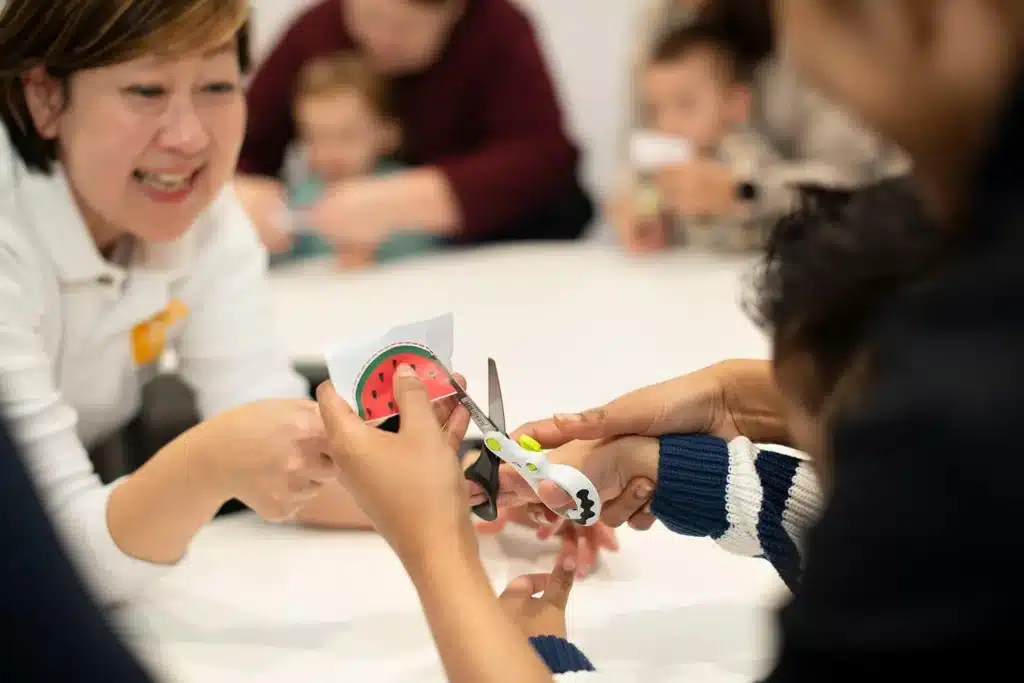
Photo by Shichida Australia, taken during a preschooler class.
Let Your Child Show You How They Learn
Most parents who notice W-sitting do not need to begin a correction routine. Look at the broader picture: Can your child move comfortably, use different positions and take part in active play without pain?
Shichida Australia offers weekly 50-minute parent-and-child classes for babies, toddlers and preschoolers from six months old, with seven centres across Sydney and Melbourne. More than 20 brief activities give children different ways to listen, look, move, think and respond.
Sit in on a real class and see how your child approaches the activities. You may be surprised by what they can focus on, understand and remember.
Frequently Asked Questions About the W-Sitting Position
W-sitting is a floor position in which a child sits with their bottom between their feet, knees bent in front and lower legs angled out beside their hips. Viewed from above, the legs form a W shape.
Current evidence does not show that W-sitting harms typically developing children. A 2024 systematic review found no association with developmental hip dysplasia and no scientific basis for routinely prohibiting the position. The evidence base is still limited, so this is more accurately described as no demonstrated harm than proof covering every child and circumstance.
The position can feel comfortable because young children naturally have more inward rotation in their thigh bones and hips. It also creates a broad base on the floor. This does not automatically mean your child has weak muscles or a developmental condition.
Research has not found that W-sitting causes developmental hip dysplasia. Femoral anteversion can make both W-sitting and in-toeing more likely, but Children’s Mercy states that W-sitting does not worsen this natural thigh-bone rotation.
There is no good evidence that occasional W-sitting weakens a child’s core. Research on muscle activation is limited, and the study discussed in the 2024 systematic review involved adults. Claims that W-sitting automatically causes core weakness therefore go beyond the available evidence.
Usually not. If your child is comfortable and uses other positions, routine correction is not supported by current evidence. You can provide varied play opportunities and occasionally make other positions convenient without making W-sitting feel forbidden.
Frequency alone has not been shown to cause hip dysplasia or other long-term problems. Look at whether your child can comfortably change positions and move in different ways. If W-sitting is the only position they can maintain, or you also notice pain, stiffness, asymmetry or movement difficulties, ask a health professional to assess the broader picture.
Children can sit cross-legged, side-sit, long-sit with their legs forward, kneel, half-kneel or use a small stool. No single position needs to be maintained all day. The useful aim is comfortable movement between a variety of positions.
There is no exact age. W-sitting is especially common in early childhood and often becomes less comfortable as femoral anteversion reduces with growth. Children’s Mercy notes that femoral anteversion generally improves naturally by around 10–12 years.
W-sitting alone is not a sign of autism and cannot diagnose low muscle tone. Some children with developmental or movement differences may use it because it feels stable, but it is also common in typically developing children. Raise any broader concerns about communication, movement or development with a qualified professional.
Seek advice if your child has pain, cannot move comfortably between positions, consistently uses their body asymmetrically, loses a movement skill or has broader difficulties with walking, balance, coordination or gross motor development.
No. Shichida is an early learning program, not physiotherapy, and it does not treat sitting posture. Classes give children varied, age-appropriate experiences involving movement, music, memory, language, thinking and hands-on learning. Speak with a health professional if you have concerns about your child’s movement.
References
- W-Sitting in Childhood: A Systematic Review. Acta Ortopédica Brasileira, 2024;32(6). doi: 10.1590/1413-785220243206e279277.
- Rethlefsen SA, Mueske NM, Nazareth A, et al. Hip Dysplasia Is Not More Common in W-Sitters. Clinical Pediatrics, 2020;59(12):1074–1079. doi: 10.1177/0009922820940810.
- Honig EL, Haeberle HS, Kehoe CM, Dodwell ER. Pediatric Orthopedic Mythbusters: The Truth About Flexible Flatfeet, Tibial and Femoral Torsion, W-Sitting, and Idiopathic Toe-Walking. Current Opinion in Pediatrics, 2021;33(1):105–113. doi: 10.1097/MOP.0000000000000977.
- Children’s Hospital Los Angeles. ‘W’ Sitting Is Not Bad for Kids, Say CHLA Experts. Published 16 June 2025.
- International Hip Dysplasia Institute. W-Sitting and Hip Development.
- Children’s Mercy Kansas City. In-Toeing.
- Boston Children’s Hospital. Femoral Anteversion.
- OrthoKids, Pediatric Orthopaedic Society of North America. Is W-Sitting Bad for My Child?.