Key Takeaways
- Knowing the alphabet involves several skills. Singing the ABC song is different from recognising letters, knowing their sounds or writing them.
- Babies and toddlers prepare for literacy by talking, listening, singing, looking at books and playing with sounds.
- Some children notice letters at two or three, often starting with the first letter of their name. Others show little interest until later.
- There is no set number of letters a two- or three-year-old should know, and children don’t need to master the alphabet before school.
- In Foundation, the Australian Curriculum includes recognising and naming uppercase and lowercase letters and learning their most common sounds.
- Letter names and sounds make more sense when they’re used in real words, stories, rhymes, drawing and early attempts at writing.
- Alphabet charts, flashcards and songs are handy tools, but the real learning happens in the back-and-forth with an adult.
One child sings the alphabet song before their second birthday. Your niece didn’t pay much attention to letters until she started kinder. Your child spots every S on a shop sign at Coles but still muddles the ABC song.
When the differences are that obvious, it’s hard not to wonder: Should my child know more by now?
There isn’t one age when children suddenly “know the alphabet”. First they notice that print means something. Then they begin to recognise shapes, remember names and connect letters with sounds. Handwriting has its own timetable.
Here is what you might see from babyhood through the first year of school, what Australian children are actually expected to learn and a few low-pressure ways to help at home.
Designed for families with children up to 5 years old.
Quick Answer: When Do Kids Learn the Alphabet?
Children often start noticing letters between two and three, and their recognition and sound knowledge build through the preschool years. They don’t need to know the whole alphabet before school. In Australia, recognising and naming uppercase and lowercase letters and learning their most common sounds are part of the Foundation curriculum.
A child who can sing the ABC song has learnt the order of the letter names. That does not necessarily mean they can recognise each printed letter, connect it with a sound or write it. These abilities develop through different experiences and at different times.

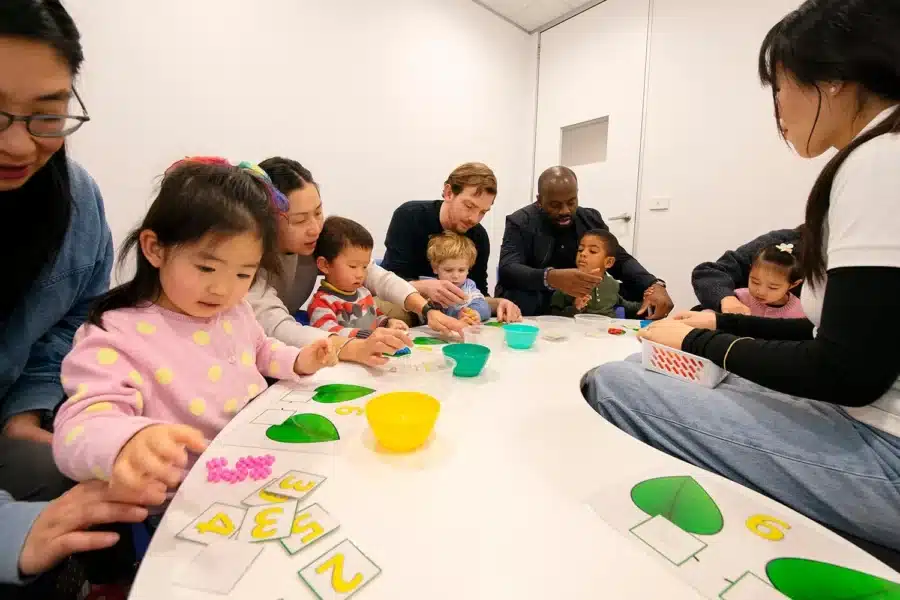
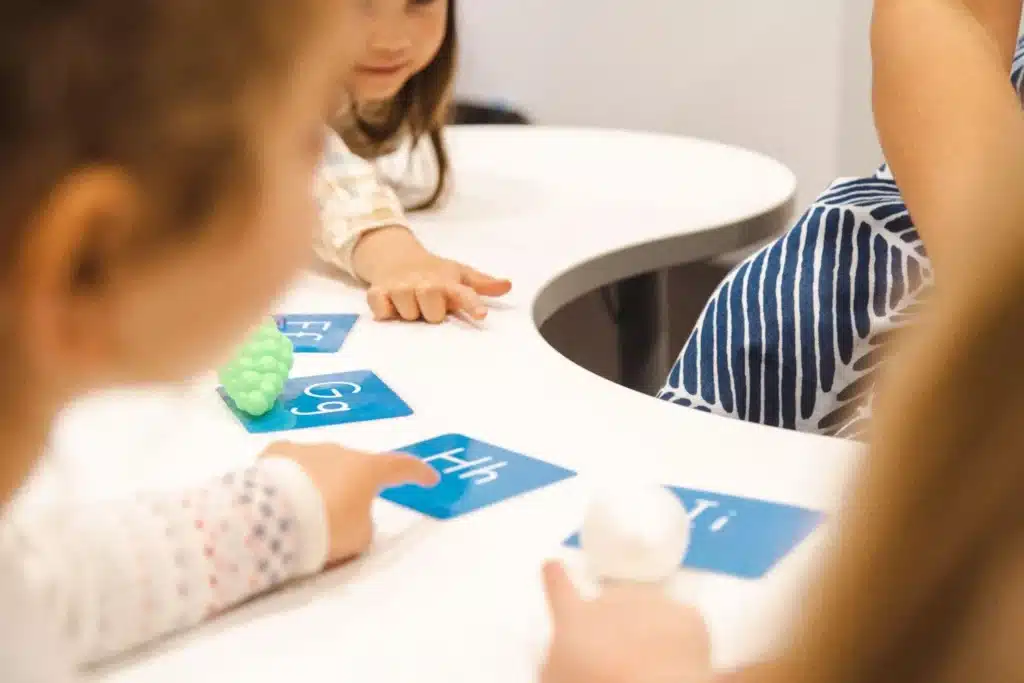
Photo by Shichida Australia, here an instructor is showing some basic phonic cards to young children.
What Does It Mean to “Know the Alphabet”?
Parents and educators can mean several things when they say a child knows their ABCs.
| Alphabet skill | What it looks like |
|---|---|
| Alphabet sequence | Singing or reciting A to Z in order |
| Letter recognition | Seeing M and knowing it is different from N or W |
| Letter naming | Looking at B and saying “bee” |
| Uppercase and lowercase matching | Knowing A and a are forms of the same letter |
| Letter–sound knowledge | Knowing b commonly represents /b/ as in ball |
| Phonological awareness | Hearing that ball and baby begin with the same spoken sound |
| Letter formation | Producing a recognisable letter by hand |
| Applying alphabet knowledge | Using letters and sounds while attempting to read or spell words |
A child can be ahead in one area and still developing another. For example, they might name many capital letters but recognise few lowercase letters. They might hear that sun and sock begin alike but not yet know which printed letter represents /s/.
So the ABC song tells you only one small part of the story.
Letter Names, Letter Sounds and Phonics
Letter names and sounds are connected, but they are not the same.
- The letter B is called “bee”.
- Its most common sound is /b/, as in ball.
- Phonics teaches how written letters and letter groups represent the sounds used in spoken words.
English has 26 letters but around 44 speech sounds in Australian English, as outlined in the Australian Government-funded Literacy Hub’s phonemic-awareness resource. The same letter or letter group can also represent different sounds. The Literacy Hub’s phonics guide for families explains that phonics teaching begins with individual letters before moving to combinations such as ch, ee and ck.
An alphabet song or poster can introduce the 26 letters, but neither is a complete phonics program.
Alphabet Learning by Age
Use the ages below as a guide, not a checklist. A child’s language, development, interests and previous experience all shape what comes next.
Birth to 2 Years: Building Language Before Letter Knowledge
Babies and young toddlers are building the listening, attention and language skills that later literacy relies on.
At this age, the good stuff is very ordinary:
- hearing adults talk and respond to them
- listening to songs and nursery rhymes
- sharing sturdy picture books
- pointing to and naming familiar objects
- making and copying sounds
- scribbling once they become interested in mark-making
There is nothing wrong with pointing out a letter or singing the alphabet song. Just don’t feel you need to teach A to Z or quiz a baby. A shared book and a proper back-and-forth conversation will do far more at this age.
The Australian Government-supported Raising Children Network recommends talking, singing, sound games, reading, drawing and writing as everyday ways to build early literacy from infancy onwards.
Ages 2 to 3: First Interest in Familiar Letters
Some toddlers begin noticing that letters are meaningful symbols. Often, the first one they recognise is the capital letter at the beginning of their name.
You might notice your child:
- recognising their written name without being able to read it letter by letter
- pointing to a familiar letter on a sign or package
- singing parts of the ABC song
- matching two identical letters
- asking what a letter says or means
- pretending to write through lines, circles and scribbles
Plenty of typically developing two-year-olds show no interest in letters at all. There isn’t an evidence-based target for how many letters a child must know at two.
If your child is curious, follow their lead. “That’s M. Mum begins with M” is enough. This gives them the information without turning the moment into a test or overwhelming them.
Ages 3 to 4: Recognition Begins to Grow
During the preschool years, many children become more aware of the print around them. They may recognise several letters, especially those in their own name and other familiar words.
They might begin:
- identifying some uppercase and lowercase letters
- matching an uppercase letter with its lowercase partner
- connecting a few letters with their common sounds
- noticing words that begin with the same sound
- finding a chosen letter in a book
- making letter-like shapes or attempting to copy familiar letters
Knowing all 26 letters by the fourth birthday is really cool, but it doesn’t need to be the goal. Letters take time – and plenty of repetition – to become familiar. Some children can read at four, while others learn much later. There is a wide range of normal development. Keep showing your child that books, writing and learning can be fun. That is a far better foundation than rushing them through an alphabet checklist.
Ages 4 to 5: Connecting Letters, Sounds and Early Writing
Between four and five, many children take a more active interest in letters and words. They may begin using their alphabet knowledge when drawing, writing their name, looking at books or playing with magnetic letters.
You might see your child:
- naming a growing range of upper- and lowercase letters
- supplying common sounds for some letters
- identifying the first sound in familiar words
- finding letters within words and names
- attempting to write their name or short messages
- asking how to spell a word
The order varies. One child may know lots of letter names but only a few sounds. Another can hear the first sound in the word sun straight away, yet can’t remember what S looks like.
Children do not need complete alphabet mastery before school. Talking, sharing books and listening for sounds are all valuable preparation. However, a child who is already comfortable with written language and understands that letters represent sounds may find early literacy lessons more familiar and feel more confident joining in.
Foundation: Formal Alphabet and Phonics Teaching
Once children begin Foundation – called Prep in Victoria and Kindergarten in NSW – alphabet knowledge becomes part of formal English teaching.
The Australian Curriculum Version 9 Foundation content description AC9EFLY11 includes recognising and naming all uppercase and lowercase letters and knowing the most common sound each represents.
Should Children Learn the Alphabet in A-to-Z Order?
Children can learn to sing the alphabet in order, but phonics instruction does not usually teach letter–sound relationships from A through Z.
As the Literacy Hub explains, schools may teach letters that can quickly be combined into words, introduce short vowel sounds early and separate letters that look or sound similar.
Before school, your child’s name is an obvious place to begin.
Parent tip: Make a few large, clear labels together using your child’s name. Place them on their bedroom door, cupboard or chair, and point the name out naturally. Recognising their own name can be useful when they start Foundation, where names are often used to label cubbies, bag hooks, tables, trays and artwork.
What Does Research Say About Teaching Alphabet Knowledge?
The Australian Education Research Organisation’s early-literacy guide recommends activities that combine alphabet knowledge – letter names and sounds – with phonological awareness.
A meta-analysis of 37 alphabet-learning studies found that instruction improves the alphabet knowledge being directly taught. Letter-sound teaching had a stronger effect on letter-sound knowledge than teaching letter names alone, and alphabet instruction was more useful when connected with sound awareness.
What does that look like at home?
- show the written letter
- say its name and common sound clearly
- listen for that sound in spoken words
- find the letter again in meaningful print
- revisit it rather than expecting instant recall
Keep the letters among conversation, new words, books, songs, rhymes and drawing. A poster gives you something to point to; it can’t have the conversation for you.
This is where flashcards can really shine. In Shichida early learning classes, flashcards are paired with spoken language, songs and games to introduce letters and words in short, pressure-free bursts. Children see and hear these ideas again through other activities, giving recognition time to build naturally. Parents also see how the activities work and can use the same playful approach at home.

Photo by Shichida Australia, taken during a preschooler early learning class.
Seven Letter Activities That Don’t Feel Like a Lesson
1. Begin With Their Name
Find the first letter of your child’s name on a card, sign or alphabet chart. Add the rest of the name when they’re ready.
2. Show, Then Ask
Give the answer before you ask for it. Try, “This is S. It makes /s/ in sun.” Later, see whether your child can find S again.
3. Go on a Letter Hunt
Choose one familiar letter and look for it in books, food packaging, numberplates and shop signs.
4. Listen for First Sounds
Choose two objects with noticeably different first sounds. Say their names slowly and help your child listen for the first sound before connecting it with a letter.
5. Match Uppercase and Lowercase Letters
Start with a few pairs, such as M m, S s and T t. Avoid presenting all 52 shapes at once.
6. Use Movable Letters or Picture Cards
Cards and magnetic letters can be sorted, matched and placed beside familiar objects. Shichida Australia’s free ABC flashcards can be used for short matching and first-sound games.
7. Read and Talk Every Day
Alphabet knowledge is not a substitute for language. Share books, describe pictures, explain unfamiliar words and let your child tell you what they think is happening.
Where an Alphabet Chart Fits
An alphabet chart helps children see all 26 letters together and gives them somewhere to look when they are trying to find or compare a letter.
Look for:
- uppercase and lowercase pairs
- a clear, familiar font
- large letters with good spacing
- simple picture cues
- strong contrast without a distracting background
Check picture cues carefully. B for ball makes the common /b/ sound easy to hear. Traditional examples such as xylophone are less straightforward because the word begins with /z/, not the /ks/ sound commonly represented by x in box.
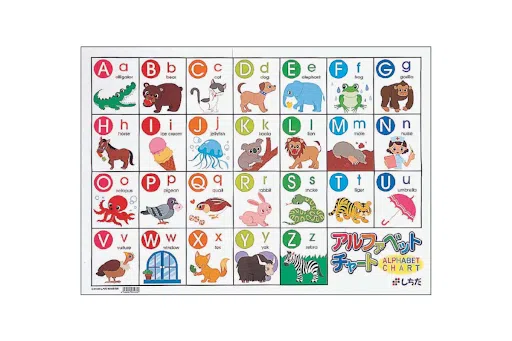
Shichida Australia’s Animal Alphabet Poster is a paid A2 laminated, waterproof poster with uppercase and lowercase letters and animal illustrations. It is made as a durable home reference for children from around six months to four years.
Use it for pointing, naming and letter hunts. Like any chart, it works best when someone uses it with the child instead of leaving it to become part of the wallpaper.
What About Learning to Write Letters?
Recognising a letter and forming it by hand are different skills. A child might know that M is the first letter of their name before they have the hand control to write it clearly.
When your child wants to write, start big:
- Trace the letter with a finger.
- Make it in the air.
- Form it with playdough or in sand.
- Copy a large version with a crayon.
- Move to smaller letters and pencils when the large shapes feel comfortable.
For more detailed writing guidance, see Learning to Write Alphabet Letters Using Activities, Worksheets and an Age Guide and pencil grip development.
Shichida Australia’s Alphabet Workbook is a more structured paid resource for children who are ready to work on letter formation.
When Should Parents Ask for Advice?
A toddler who doesn’t know letters isn’t automatically showing a developmental problem. Letters are only one piece of what you’re seeing.
It may be worth speaking with your child’s preschool educator, classroom teacher or GP if you also have concerns about:
- hearing or vision
- understanding or using spoken language
- speech sounds
- remembering skills that have been explicitly taught and practised
- ongoing difficulty following classroom literacy instruction
- frustration that is making reading or writing consistently distressing
For a school-aged child, start with the teacher. They know what has been taught, can see how your child manages in class and can tell you whether extra support may help.
How Letters and Language Appear in Shichida Classes
Alphabet work takes up only a small part of a Shichida lesson. Letters and phonics appear alongside songs, vocabulary, stories, memory activities, early numeracy, problem-solving and fine-motor tasks. With more than 20 short activities in a lesson, children are rarely doing one thing for long.

Photo by Shichida Australia, here a toddler is playing a category matching game alongside a parent. They briefly discuss each object before placing it in the category it belongs to.
Teachers show the material clearly and bring skills back again in later lessons. A child isn’t expected to answer correctly every time. Parents attend with children under five, so they can see which activities hold their child’s attention and borrow ideas for home.
Shichida doesn’t replace the phonics sequence taught at school, and it isn’t specialist literacy support. It gives young children a wider early learning class in which letters and sound awareness are included, without making them the whole lesson.
What About Numbers?
Written numbers take time too. The symbol 3 means more when a child can match it with three objects and count them.
Shichida Australia has math flash cards and other activities in its Free Resources collection.
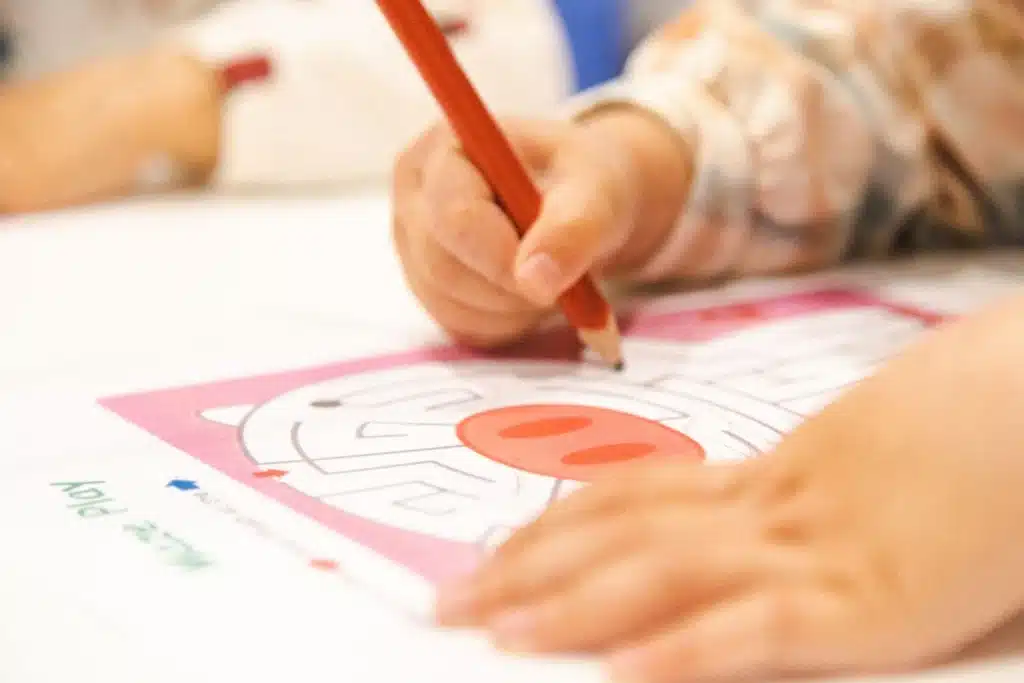
Photo by Shichida Australia: A preschooler completes a maze, building problem-solving skills, pencil control and hand endurance – this makes later writing easier and less tiring for young children.
See How Your Child Responds to Shichida
There is no prize for rushing a young child through the alphabet. Let them hear plenty of language, show them letters clearly and bring familiar ideas back without making every encounter a quiz.
Shichida Australia runs fun weekly 50-minute parent-and-child classes from six months of age. Each lesson moves through 20–25 brief activities involving language, memory, concentration, early numeracy and problem-solving.
New enrolments are accepted up to age five, with centres across Sydney and Melbourne.
The best way to judge whether the pace and style suit your child is to see a class for yourself.
Book a Shichida trial class or learn more about Shichida Australia.
FAQs About Kids Learning the Alphabet
Children often begin noticing letters between two and three years old, with recognition and letter-sound knowledge growing throughout the preschool years. Formal alphabet and phonics teaching continues during Foundation. Development varies, so there is no single birthday by which every child should know all 26 letters.
There is no required number. Some two-year-olds recognise the first letter of their name or a few familiar letters, while others are not interested yet. Conversation, songs, books and play are more important than testing letter totals at this age.
There isn’t a universal target. Your three-year-old may notice their name, signs or matching letters, or may be far more interested in something else. Look for progress over time, not a score out of 26.
Not necessarily. Many four-year-olds know a growing collection of letters and common sounds, but complete mastery isn’t a school-entry requirement. Use names, books and sound games instead of drilling the full alphabet.
The song is a memorised sequence; recognising a printed letter is a separate job. Work with a few familiar letters at a time instead of repeatedly testing all 26.
Children need both. Uppercase letters are common in names and signs, while lowercase letters appear more frequently in books and sentences. Showing both forms together helps children understand that A and a represent the same letter.
You can introduce both together: “This is B. Its common sound is /b/ as in ball.” Letter names identify the symbols, while sounds help children connect print with spoken words.
No. Children can learn the alphabet song in order, but schools generally teach letter–sound relationships in a planned phonics sequence. At home, the letters in your child’s name are a meaningful starting point.
Yes, if you use it together. Point to a letter, say its name and sound, connect it with a familiar word and look for it somewhere else. A chart that is never talked about quickly becomes wallpaper.
You never need to wait for a particular milestone to ask. Speak with the teacher if your school-aged child keeps forgetting letters and sounds that have been directly taught, or if literacy work is causing a lot of frustration. The teacher can put that concern in the context of the child’s classroom learning.
Letters, phonics, vocabulary and early writing appear within the Shichida program, but Shichida is not a stand-alone alphabet course or reading intervention. These experiences are combined with memory, thinking, numeracy, fine-motor and other age-appropriate activities.
References
- Australian Curriculum, Assessment and Reporting Authority. Foundation English Content Description AC9EFLY11. Australian Curriculum Version 9.0.
- Australian Education Research Organisation. Early Literacy Practice Guide. Updated 10 June 2024.
- Australian Government-funded Literacy Hub. Phonics: A Guide for Families.
- Australian Government-funded Literacy Hub. Phonemic Awareness: 44 Sounds.
- Piasta SB, Wagner RK. Developing Early Literacy Skills: A Meta-Analysis of Alphabet Learning and Instruction. Reading Research Quarterly. 2010;45(1):8–38.
- NSW Department of Education. Learn About Letters and Their Sounds.
- Raising Children Network. Literacy Activities for Children: Ideas for Every Stage. Supported by the Australian Government Department of Social Services.
- National Early Literacy Panel. Developing Early Literacy: Report of the National Early Literacy Panel. National Institute for Literacy, 2008.