
Key Takeaways
- The average IQ score for a child is 100. Tests are adjusted by age, so children are compared with other children of the same age.
- Around two-thirds of children score between 85 and 115. This is commonly described as the average range.
- A percentile is different from a percentage. A score at the 75th percentile does not mean the child answered 75% of the questions correctly.
- One score should not be interpreted in isolation. A child’s index scores, development, learning history and day-to-day functioning provide important context.
- IQ does not capture the whole child. Creativity, motivation, emotional intelligence, confidence, curiosity and social skills are not fully measured by a standard IQ test.
An IQ score can look very precise, but what does the number actually tell you about your child?
IQ score ranges for children show how a child performed on a standardised set of cognitive tasks compared with other children of the same age. They can provide useful information about areas such as reasoning, memory and problem-solving, but they cannot measure every kind of ability or predict a child’s future.
Designed for families with children up to 5 years old.
Quick Answer: What Are the IQ Score Ranges for Children?
On many widely used IQ tests, the average score is set at 100. Around 68% of children score between 85 and 115. A score of 130 is approximately at the 98th percentile, while a score of 70 is approximately at the 2nd percentile.
These ranges describe performance on a particular test. They are not grades, pass-or-fail results or complete measures of a child’s potential.
Child IQ Score Chart
The table below shows a commonly used distribution for tests with an average of 100 and a standard deviation of 15.
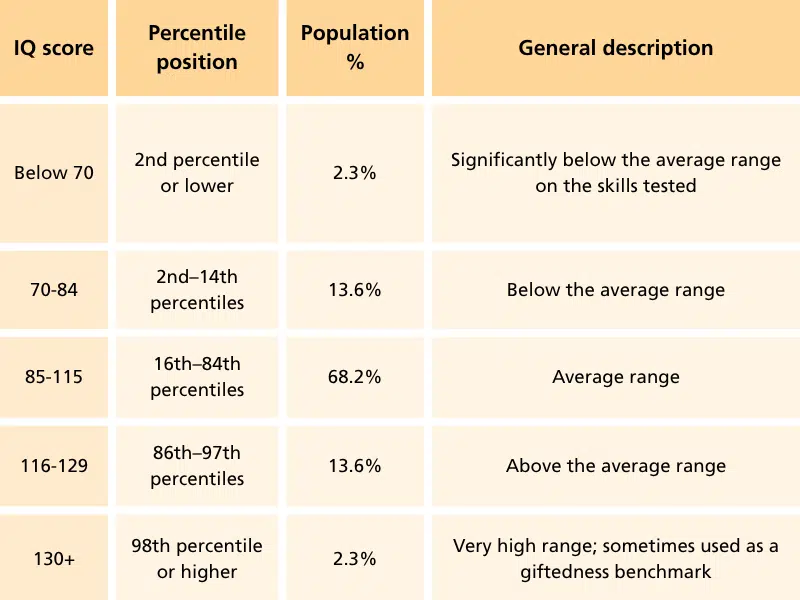
These percentages and percentiles are approximate. Tests and organisations may use different names or cut-off points for score ranges. Pearson notes that qualitative labels are suggested ways of communicating results rather than evidence-based descriptions of a child.
How Does the IQ Bell Curve Work?
IQ scores are commonly arranged along a bell-shaped curve. Most scores sit near the centre, with progressively fewer scores at the higher and lower ends.
The centre of the curve is 100. On tests using a standard deviation of 15:
- Around 68% of children score within 15 points of 100: between 85 and 115.
- Around 95% score within 30 points of 100: between 70 and 130.
- Only a small percentage score below 70 or at 130 and above.
This is a comparison with the test’s norm group. It does not mean that children near the centre are all alike or that children outside the centre will have the same strengths, needs or experiences.
IQ Score and Percentile Chart for Children
A percentile tells you where a score sits in relation to same-age children in the test’s comparison group.
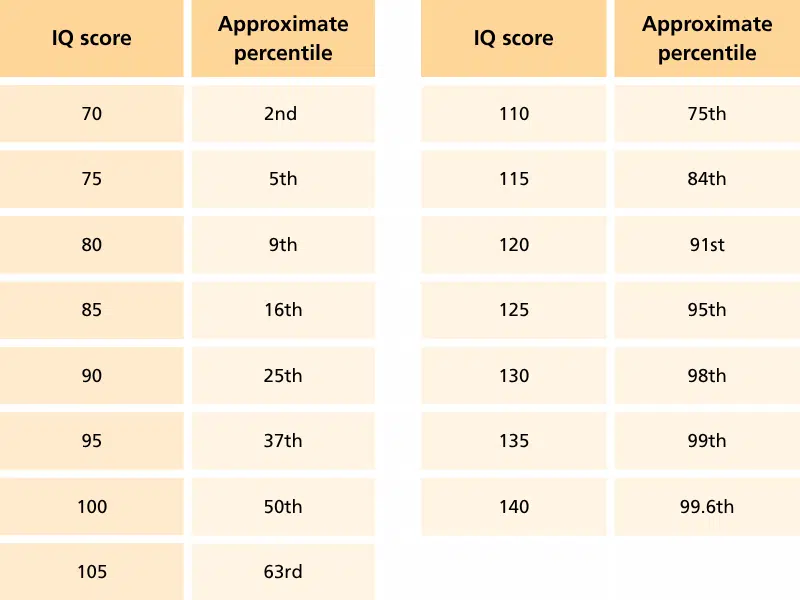
For example, an IQ score of 120 is approximately at the 91st percentile. This means the result was equal to or higher than the results of roughly 91% of same-age children in the norm group. It does not mean the child answered 91% of the test correctly.
Why Is the Average IQ 100 at Every Age?
Children do not need to reach a higher IQ number as they get older. IQ tests are age-normed, which means a child’s performance is compared with the performance of children in the same age group.
A five-year-old and a ten-year-old can both receive an IQ score of 100, even though the older child completes more advanced tasks. In each case, 100 indicates performance close to the average for that child’s age.
This is why an age-by-age list showing a different “ideal IQ” for each birthday would be misleading. You can read more in our guide Average IQ for kids by age.
What Does Each Child IQ Score Range Mean?
IQ Below 70
A score below 70 indicates that a child performed significantly below most same-age children on the cognitive skills measured by that test. It may lead a psychologist to look more closely at the child’s learning and support needs.
However, an IQ score alone does not diagnose an intellectual disability. Assessment also considers adaptive functioning – how a child manages communication, social understanding, self-care and everyday tasks – as well as developmental history and other evidence. The American Association on Intellectual and Developmental Disabilities states that both intellectual functioning and adaptive behaviour must be considered.
Parents should discuss a result in this range with the psychologist who completed the assessment rather than drawing conclusions from the number alone.
IQ From 70 to 84
This range is below the statistical average, but it does not automatically mean that a child has a learning disability or intellectual disability.
The child may benefit from extra support in particular areas, or the full assessment may reveal a mixed profile. For example, verbal reasoning may be stronger than working memory or processing speed. Language background, attention, anxiety, fatigue and the suitability of the assessment can also affect performance.
The most useful question is not simply, “Is this score low?” It is, “What does the full assessment tell us about how this child learns and what support would help?”
IQ From 85 to 115
Most children score within this broad average range. A score here means the child’s overall performance was reasonably close to that of most children their age.
An average Full-Scale IQ does not mean that every skill is average. A child may have strong visual reasoning alongside weaker processing speed, or strong verbal skills alongside difficulty holding information in working memory. Looking at the individual index scores can provide more useful information than the overall number.
Children within this range can also have specific learning difficulties, advanced abilities, creative strengths or emotional needs that are not apparent from the total score.
IQ From 116 to 129
A score between 116 and 129 is above the average range. It suggests that the child performed more strongly than most same-age children across the tasks contributing to the score.
This may appear in everyday learning as quick pattern recognition, strong reasoning or an ability to understand new ideas with less repetition. However, children with similar overall scores can still have very different profiles.
An above-average result should not become pressure to perform. Children still need appropriate challenge, room to make mistakes, emotional support and time for play.
IQ of 130 or Above
An IQ score of 130 is approximately at the 98th percentile and is often used as one indicator of giftedness. Requirements for gifted programs vary, and some use different thresholds or consider achievement, creativity, teacher observations and other evidence.
The National Association for Gifted Children recommends using multiple forms of assessment rather than relying on one test score. A high IQ result can help identify learning needs, but it does not describe a child’s personality, emotional development, motivation or abilities in every area.
What Skills Do Children’s IQ Tests Measure?
The exact tasks depend on the assessment and the child’s age. Widely used Wechsler assessments can provide information across areas such as:
- verbal comprehension
- visual-spatial thinking
- fluid reasoning
- working memory
- processing speed
A Full-Scale IQ combines performance across selected tasks into one overall score. Psychologists may also report separate index scores. These can show whether a child’s abilities are relatively even or whether there are meaningful differences between areas.
In Australia and New Zealand, the Wechsler Preschool and Primary Scale of Intelligence (WPPSI-IV A&NZ) is designed for children aged 2 years 6 months to 7 years 7 months. The Wechsler Intelligence Scale for Children (WISC-V A&NZ) covers ages 6 years to 16 years 11 months. Both must be used and interpreted by appropriately qualified professionals.
How Reliable Is an IQ Score for a Young Child?
Age-appropriate cognitive assessments are available for preschool-aged children, but results in the early years need careful interpretation.
Young children are developing rapidly and may respond differently depending on their language, attention, comfort with the examiner, health, tiredness or mood. The National Association for Gifted Children notes that accurate IQ determinations can be difficult before age six and recommends considering observations, parent and teacher information, interviews and other evidence.
A formal report may also include a confidence interval around the score. This reflects the fact that an IQ result is an estimate, not a perfectly exact measurement. The Australian Psychological Society recommends interpreting a student’s pattern of strengths and weaknesses rather than focusing on a single test score.
Can a Child’s IQ Score Change?
A child’s score can differ when they are assessed again, particularly during the early years. This does not necessarily mean that a child has suddenly become more or less intelligent.
Differences may reflect development, the test used, the interval between assessments, changes in learning opportunities or factors affecting the child during either assessment. Practice effects can also influence results if the same test is repeated too soon.
For parents, the more useful focus is whether the assessment leads to suitable support. A score should help adults understand a child’s current learning profile; it should not become a permanent label.
What an IQ Score Does Not Measure
An IQ test measures specific cognitive abilities under standardised conditions. It does not fully measure:
- creativity and imagination
- emotional intelligence
- empathy and social understanding
- motivation and persistence
- confidence
- practical abilities
- artistic or musical ability
- curiosity and love of learning
These qualities can strongly influence how children learn, form relationships, respond to challenges and apply their abilities in daily life.
Shichida Australia offers parent-child early learning classes for families in Australia, using the Shichida Method for fun learning experiences.

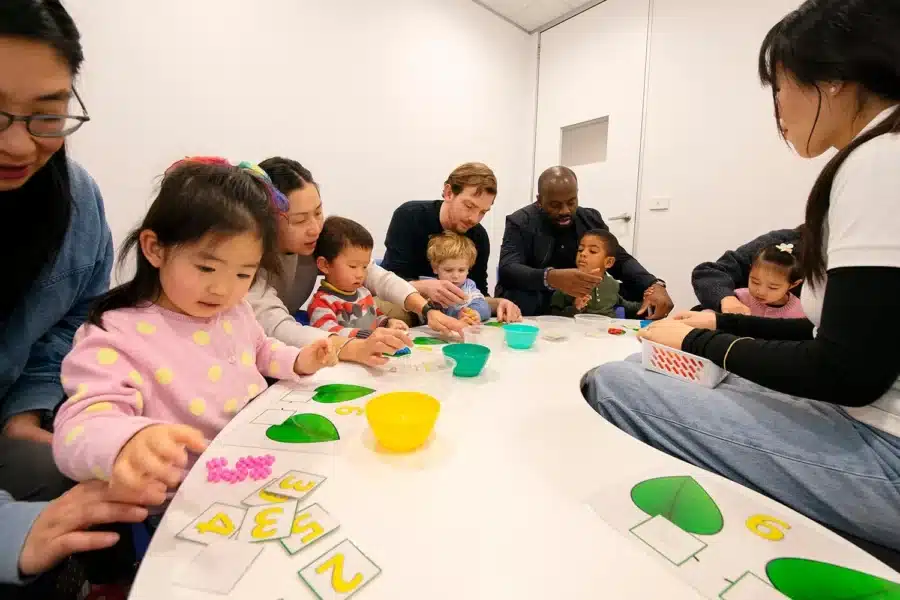
Photo by Shichida Australia – children and parents completing educational activities together during a fun early learning class.
When Might a Child Need Cognitive Assessment?
Parents may consider speaking with a qualified psychologist when:
- a child is having persistent learning difficulties
- there is a large difference between apparent ability and school performance
- a teacher or health professional has raised developmental concerns
- advanced learning needs are not being met
- an assessment is required to plan appropriate educational support
The reason for testing should be clear. A comprehensive assessment usually draws on more than one source, including developmental history, interviews, observation, school information and standardised measures.
Online quizzes and informal activities cannot provide a clinically valid IQ score. If you want to understand your child’s learning needs, speak with a registered psychologist experienced in child assessment. Read our IQ Test for Kids: A Comprehensive Guide for more information about the process.
How Can Parents Support Cognitive Development?
Parents do not need to train children for IQ tests. Everyday experiences can support the abilities children use for learning:
- Read together and talk about the story.
- Make room for questions and help your child think through possible answers.
- Use puzzles, blocks, sorting, drawing and memory games.
- Let your child attempt age-appropriate problems before stepping in.
- Talk through sequences such as getting dressed, following a recipe or preparing for an outing.
- Support healthy routines, including sleep, active play and balanced meals.
- Help your child name emotions, recover from mistakes and try again.
- Notice effort, strategies and progress rather than comparing scores.
- Choose a weekly activity to do together – this creates routine and time set aside for each other.
The goal is not to chase a higher IQ score number, but to build a broad base of cognitive, emotional and practical skills that children can use across learning and life.
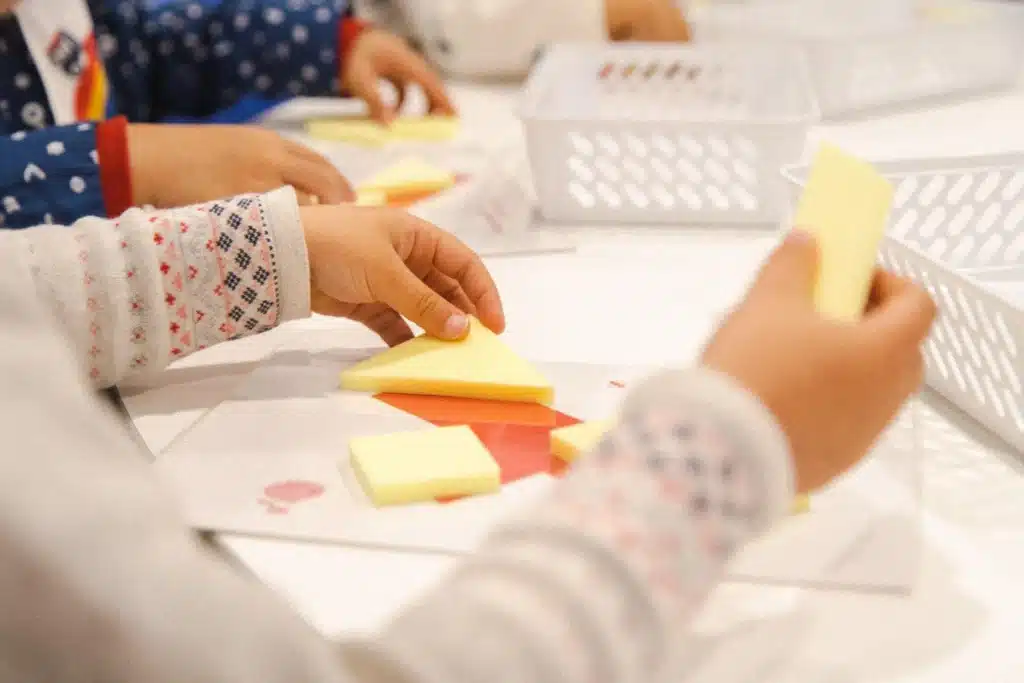
Photo by Shichida Australia – preschoolers attempting a tangram puzzle challenge.
Support Early Cognitive and Emotional Development
At Shichida Australia, weekly parent-and-child classes use varied, age-appropriate activities to build memory, concentration, language, problem-solving, confidence and emotional skills.
The program takes a whole-child approach, supporting both IQ and EQ as part of the broader developmental picture.
Shichida offers fun early learning classes across Sydney and Melbourne for children aged 6 months to 5 years. Children who enrol before age 5 can continue into the Primary School Program up to age 9.
FAQs About IQ Score Ranges for Children
The average IQ score for a child is 100. Because recognised IQ tests are age-normed, a child is compared with other children of the same age.
There is no pass or fail. Around 68% of children score between 85 and 115, which is commonly called the average range. A useful result is one that helps parents and professionals understand a child’s strengths and support needs.
Yes. A score of 120 is above average and sits at approximately the 91st percentile. It indicates stronger performance than most same-age children on the abilities measured by the test, but it does not measure every form of ability.
A score of 130 or above is often used as one indicator of giftedness and is approximately at the 98th percentile. However, schools and gifted programs may use different criteria and may consider several forms of evidence.
It indicates performance significantly below most same-age children on that assessment. It is not, by itself, a diagnosis of intellectual disability. A qualified professional must also consider adaptive functioning, developmental history and other information.
The statistical average is 100, just as it is for older children. The tasks are adjusted for the child’s age, so a five-year-old is compared with other five-year-olds. “Average range” is generally a more helpful term than describing an individual child as normal or abnormal.
Yes. Scores can change, particularly in young children. Development, learning experiences, the assessment used and test-day factors can all influence results. A score is best treated as an estimate of current performance, not a permanent label.
An online test cannot provide a clinically valid IQ score. Formal cognitive assessments must be selected, administered and interpreted by a suitably qualified professional using standardised procedures.
No. School progress is also influenced by motivation, attention, emotional wellbeing, teaching, learning differences, confidence and support. A high score may identify advanced cognitive ability, but it does not guarantee achievement or wellbeing.
No. IQ tests measure a defined group of cognitive skills. They do not fully capture creativity, emotional intelligence, social abilities, motivation, practical skills or how a child may develop over time.
References
- Australian Psychological Society and Speech Pathology Australia: Practice Guide for the Assessment of School-Age Students
- Pearson Clinical Assessment AU&NZ: WISC-V Australian and New Zealand Standardised Edition
- Pearson Clinical Assessment AU&NZ: WPPSI-IV Australian and New Zealand Standardised Edition
- National Association for Gifted Children: Assessments and Tests
- American Association on Intellectual and Developmental Disabilities: Frequently Asked Questions on Intellectual Disability
This article provides general information only. It cannot interpret an individual child’s assessment or replace advice from a qualified psychologist or health professional.